🔔 Announcement: American Trucking Insurance is now a part of Valley!
See details
🔔 Announcement: American Trucking Insurance is now a part of Valley!
See details

When Drivers Go Off-Script: Accident Liability Outside Dispatch Orders

Cameron Pechia / Jun 10, 2026
Reviewed by Cameron Pechia, Founder, WA Insurance License 71186
Last reviewed: 5/01/2026
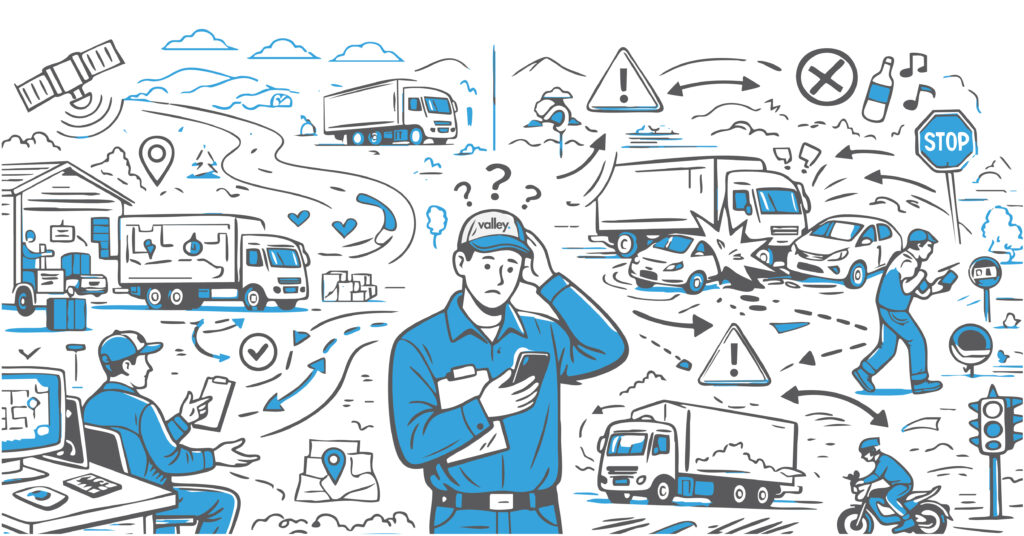
Key takeaway: Trucking accident liability outside dispatch orders refers to the legal and insurance exposure a fleet owner faces when one of their drivers causes an accident while operating outside an assigned load, route, or authorized use of the truck. In most cases, the fleet can still be held liable — either through the doctrine of respondeat superior (employer liability for employee actions), negligent entrustment, or both. Whether the driver was “off the clock,” running a personal errand, or simply deviating from the assigned route, your commercial auto policy and your business’s legal exposure may both be triggered. This applies to employee drivers and, depending on the facts, to leased owner-operators as well.
Your driver caused an accident. First thing you do is check the dispatch records. He wasn’t on an active load. He took the truck somewhere he wasn’t supposed to be. You figure the claim has nothing to do with you.
It does.
This is one of the most expensive misconceptions in trucking. “Unauthorized” doesn’t mean “uninsured” and it doesn’t mean “not your problem.” The legal doctrines that govern fleet liability don’t care much about what dispatch said. They care about who owned the truck, who controlled the driver, and whether you did anything — or failed to do anything — that made the accident more likely. Let’s go through how this actually works.
Why “He Wasn’t On a Dispatched Load” Doesn’t Close the Claim
This is the thought that gets fleet owners into trouble. The logic sounds reasonable: if a driver took the truck somewhere unauthorized, that’s the driver’s problem, not yours.
Courts don’t see it that way. The question isn’t whether you authorized the specific trip. The question is whether the driver was acting in a capacity that reasonably connects to their role as your employee. And in trucking, that connection is hard to sever completely.
Under 49 CFR Part 390, the Federal Motor Carrier Safety Regulations apply to all employers, employees, and commercial motor vehicles transporting property in interstate commerce. They establish the operational framework within which your drivers work — and that framework follows the truck and the employment relationship, not just the load.
Two separate legal doctrines create liability in these situations. One is respondeat superior. The other is negligent entrustment. You can face one, the other, or both — and each operates independently.
What Respondeat Superior Actually Means for Fleet Owners
Respondeat superior is a Latin legal doctrine meaning, roughly, “let the employer answer.” When an employee causes harm while acting within the scope of their employment, the employer shares legal responsibility for that harm. Courts have applied this to trucking accidents for decades.
The critical phrase is “scope of employment.” It’s broader than most fleet owners expect. A driver doesn’t have to be actively hauling freight on a dispatched load to be considered within scope. Driving to pick up paperwork, repositioning the truck for the next day’s run, fueling up on a route the company uses — all of these can fall within the scope of employment even without a specific dispatch tied to them.
The Frolic and Detour Distinction
Courts break unauthorized driver activity into two categories, and the difference matters enormously for liability.
A “detour” is a minor deviation from the employee’s duties — still close enough to the job that the employer remains responsible. A driver who stops for lunch on the way to a delivery and causes an accident during that stop is likely still within the employment relationship. The detour was small. The underlying purpose of the trip was work.
A “frolic” is a major departure — the employee abandoned the job entirely for personal purposes unrelated to their work. A driver who takes the truck on a weekend road trip for personal reasons may have gone far enough off-script that the employer is no longer liable under respondeat superior.
The critical word is “may.” Courts draw that line based on the specific facts: how far off-route the driver went, how long they were gone, whether the activity had any connection to their job, and whether there’s evidence they were returning to work when the accident happened. Frolic and detour doctrine is almost entirely state-level common law, which means outcomes vary by jurisdiction. What reads as a clear “frolic” to you may look like a borderline “detour” to a plaintiff’s attorney — and juries decide those calls.
Negligent Entrustment: The Liability That Ignores Dispatch Status Entirely
Here’s where the “unauthorized” defense falls apart entirely. Negligent entrustment is a direct liability claim against the fleet owner — not a vicarious one. It doesn’t matter whether the driver was on a dispatched load. It doesn’t matter whether they were acting within the scope of employment. The claim is about what you knew when you handed over the keys.
Negligent entrustment occurs when a fleet owner allows an unqualified or unsafe driver to operate a company truck, knowing — or having reason to know — that the driver posed a risk. Courts look at the driver’s history: prior accidents, moving violations, license suspensions, drug and alcohol record. If a driver with a checkered record causes an accident while using your truck for any reason, a plaintiff’s attorney will argue you were negligent for letting that driver have access to the vehicle in the first place.
The FMCSA’s Pre-Employment Screening Program (PSP) exists precisely because this exposure is real. Pulling a driver’s PSP record before hiring, conducting proper background checks under 49 CFR Part 391, and reviewing MVRs annually as required by 49 CFR § 391.25 are not just compliance requirements — they are the paper trail that shows you were not negligent in who you put behind the wheel.
This matters even when a driver goes completely off-script. Courts have been clear: a fleet owner does not escape negligent entrustment liability simply because the driver was on a frolic at the time of the accident.
What Your Commercial Auto Policy Actually Covers
This is where fleet owners often get their first surprise after an accident. Your commercial auto policy follows the truck, not the load. If a covered driver gets into an accident in a covered vehicle, the policy responds — regardless of whether there was a dispatched load on the trailer.
Most commercial trucking policies include language defining covered drivers and covered uses. If your driver is listed on the policy, driving a scheduled unit, the accident is typically a covered event even if the trip was unauthorized. You may face a denial or coverage dispute if the driver was explicitly excluded from the policy or if the use of the vehicle was specifically prohibited under the policy terms. But unauthorized doesn’t automatically mean excluded.
Non-Trucking Liability vs. Bobtail Coverage
Two related products are worth knowing here. Non-trucking liability (NTL) and bobtail coverage both address situations where a truck is being driven outside of active dispatch. The distinction matters:
Bobtail coverage applies when a truck is being operated without a trailer — typically when deadheading between loads or returning from a delivery. Non-trucking liability applies when the truck is being used for personal purposes outside of the business’s commercial operations.
Neither is automatically included in a standard commercial auto policy. If your fleet doesn’t carry one of these, there may be a coverage gap during the exact periods when drivers are most likely to operate outside dispatch — repositioning, personal use with permission, or running errands in the truck.
When the Driver Is an Independent Contractor, Not an Employee
The respondeat superior doctrine typically applies to employees, not independent contractors. If your fleet uses leased owner-operators dispatched under your authority, the liability picture gets more complicated.
FMCSA leasing regulations under 49 CFR Part 376 require that during the period a truck operates under a lease, the authorized motor carrier — you — bears full responsibility for that vehicle’s operation. That includes accidents that occur outside active dispatch during the lease period. An owner-operator under your authority is not cleanly insulated from your liability exposure, and you are not cleanly insulated from theirs.
Independent contractor classification is sometimes challenged in litigation. If a plaintiff can argue that you exercised sufficient control over the driver’s daily operations, the court may treat them as an employee for liability purposes regardless of how the contract reads. Trucking operations with owner-operators should make sure their leasing agreements, dispatch practices, and policy documentation all reflect the actual operational relationship accurately — not just the preferred one.
The Paper Trail That Changes the Outcome
I’ve seen claims where the fleet owner had a solid defense — the driver really was on a personal frolic, the use really was prohibited, the written policy was clear. They still paid significant defense costs and spent months in litigation before that defense held up.
The difference between a quick claim resolution and a drawn-out fight usually comes down to documentation. Specifically:
A written vehicle use policy, signed by every driver, that defines authorized and unauthorized uses of fleet equipment. Clear dispatch records that establish where each driver was supposed to be and when. MVR reviews conducted annually per 49 CFR § 391.25, with records retained. Signed acknowledgment from each driver that they understand the vehicle use policy and consequences of unauthorized use. GPS or telematics records, which provide objective evidence of where the truck was when the accident happened.
That documentation serves two purposes: it supports your frolic defense if you need it, and it demonstrates you were not operating negligently. Without it, you’re asking a jury to take your word for where the truck was supposed to be — and juries in trucking cases don’t typically give fleet owners the benefit of the doubt.
What to Do Right Now If You Don’t Have a Driver Use Policy
If your fleet doesn’t have a written vehicle use policy, that’s the first thing to fix. It doesn’t have to be complicated. The policy needs to cover three things: who is authorized to drive fleet vehicles, what uses are permitted and what uses are prohibited, and what happens when a driver violates the policy.
Have every driver sign it. Keep copies. Review it annually and update it when the fleet or driver roster changes.
Then pull your commercial auto policy and read the driver exclusions and covered use definitions. Know what your policy covers and what it doesn’t. Specifically: does your policy cover personal use by listed drivers? Do you carry non-trucking liability or bobtail coverage for trips outside dispatch? Are all your regular drivers listed, including leased owner-operators?
If you’re not sure what you have or whether it’s enough, that’s the conversation to have with your broker before there’s a claim on the table.
Every fleet operation has moments when trucks are in motion outside a dispatched load. Repositioning. Personal garaging. A driver making a quick stop. How much exposure you carry in those moments depends on what your policy says, what your documentation shows, and whether your broker helped you structure coverage for the operation you actually run — not the one that looks clean on paper.
If you’re not sure your coverage reflects reality, get a review now. Send your information to Valley Trucking Insurance and we’ll take a look at what you have, what’s missing, and what it would take to close those gaps before a claim makes that decision for you.
Frequently Asked Questions
Can a fleet owner be held liable if a driver causes an accident while using the truck without permission?
Yes. Both respondeat superior and negligent entrustment can create liability even when the use was unauthorized. Respondeat superior depends on whether the driver was still acting within the employment relationship; negligent entrustment depends on what the fleet owner knew about the driver’s fitness when they were given access to the vehicle.
What is the difference between a frolic and a detour in trucking liability?
A detour is a minor deviation from assigned duties — courts typically still hold employers liable. A frolic is a major departure for purely personal purposes — employers may avoid respondeat superior liability, but not necessarily negligent entrustment liability. The line is drawn case by case under state common law.
Does commercial auto insurance cover accidents that happen outside a dispatched load?
Usually yes, if the driver is listed and the vehicle is scheduled on the policy. Unauthorized use doesn’t automatically mean excluded use. Review your policy’s covered use definitions and driver exclusions to know exactly what situations are covered.
What is non-trucking liability coverage and when does it apply?
Non-trucking liability (NTL) covers a truck being used for personal purposes outside of active commercial dispatch. It typically applies when the truck is not under a load and is being used for purposes unrelated to the fleet’s business operations. It’s separate from bobtail coverage, which applies when the truck is running without a trailer.
How does FMCSA’s leasing rule affect liability for owner-operators operating outside dispatch?
Under 49 CFR Part 376, the authorized fleet bears responsibility for a leased truck’s operation during the lease period — including accidents outside active dispatch. Owner-operators under your operating authority are not an automatic liability firewall.
What records does a fleet need to defend against a claim involving an unauthorized driver use?
Written vehicle use policy signed by all drivers, dispatch records showing authorized routes and loads, annual MVR reviews per 49 CFR § 391.25, driver qualification files meeting FMCSA requirements, and GPS or telematics data. These records support both a frolic defense and a showing that the fleet was not negligently managed.
Can a fleet owner be found negligent for an accident during a frolic if the driver had a bad driving record?
Yes. Negligent entrustment operates independently of the frolic and detour defense. If a fleet owner knew — or should have known — that a driver was unfit, liability can attach even if the accident occurred during a personal trip entirely unconnected to work.
Does the driver being off the clock affect the fleet’s liability?
Not automatically. Courts look at the totality of the circumstances — who owned the truck, whether the driver was listed on the policy, whether the use was explicitly prohibited, and whether the trip had any connection to the employment relationship. “Off the clock” is not a liability defense on its own.

Smarter Coverage. Real Support. No Hassle.