🔔 Announcement: American Trucking Insurance is now a part of Valley!
See details
🔔 Announcement: American Trucking Insurance is now a part of Valley!
See details

Trucking Broker Scam Liability: Who Really Pays When a Trucker Gets Scammed

Cameron Pechia / Dec 23, 2025
Reviewed by Cameron Pechia, Founder, WA Insurance License 71186
Last reviewed: 3/18/2026
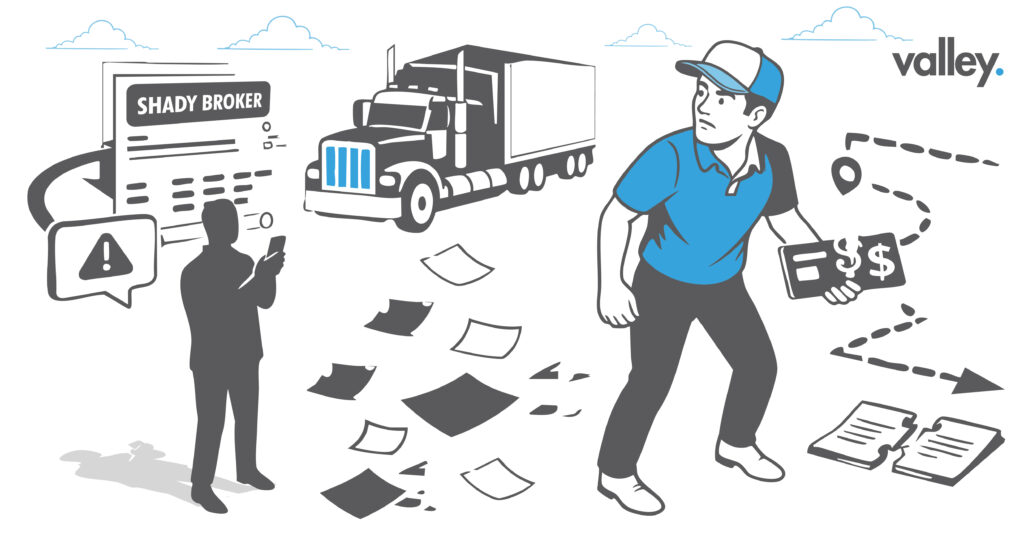
Freight scams are no longer rare. They are part of the daily risk in trucking. Every week, carriers lose money to fake brokers, double-brokered loads, or payment schemes that look legitimate until it is too late. When a scam happens, the first reaction is usually anger toward the broker. But the real question comes next. Who actually pays when a trucker gets scammed?
The uncomfortable truth is this. In many cases, the trucker or the carrier absorbs most of the loss. Brokers, shippers, and insurers do not always step in the way people expect. Understanding how liability really works helps fleets protect cash flow, avoid repeat losses, and build stronger defenses against fraud.
This guide explains how freight scams happen, who is financially responsible, how insurance responds, and what carriers can do to protect themselves before the next load is booked.
Quick Answer
When a trucker gets scammed by a shady broker, the carrier usually pays the price. Unpaid freight charges, cargo losses, towing fees, and legal costs often fall on the trucker. Broker bonds may offer limited recovery, but they rarely cover the full loss. Insurance usually does not cover fraud related to nonpayment. Prevention and verification are the strongest protections.
Why Freight Broker Scams Are So Common
Scammers target trucking because the industry moves fast. Loads are booked quickly. Payments are delayed. Verification often happens under time pressure. Criminals exploit these conditions.
Speed Over Verification
Many carriers accept loads within minutes. When rates look good and trucks need to move, verification steps get skipped.
Public Information Is Easy to Copy
DOT numbers, MC numbers, and company names are public. Scammers copy real broker identities and impersonate them convincingly.
Payment Delays Hide the Scam
By the time a carrier realizes payment is not coming, the freight is already delivered. At that point, leverage is gone.
New Carriers Are Vulnerable
New owner operators are especially targeted. Scammers know new carriers are eager for loads and less familiar with red flags.
How the Most Common Broker Scams Work
Understanding the patterns helps carriers spot trouble earlier.
Fake Broker Impersonation
A scammer pretends to be a legitimate broker. They copy the real broker’s MC number and branding. The carrier hauls the load, but the scammer disappears after delivery.
Double Brokering Without Disclosure
A real broker reassigns the load without permission. The carrier delivers freight but never gets paid because the original broker claims no contract existed.
Rate Confirmation Manipulation
Payment terms are altered. Email domains are slightly changed. Instructions look real but send paperwork to the wrong party.
Payment Redirection Schemes
Scammers intercept email communication and change payment instructions so funds go to a fraudulent account.
The FMCSA explains broker bonding requirements and why bonds exist, which helps clarify where recovery may be possible through the FMCSA broker bond overview.
Who Pays When the Scam Is Discovered
This is where reality sets in.
The Carrier Usually Takes the First Hit
Fuel, labor, tolls, and time are already spent. If the broker does not pay, the carrier absorbs the immediate loss.
Shippers Often Say It Is Not Their Problem
Shippers usually pay the broker they contracted with. If the broker was fake or double brokered the load, shippers often refuse to pay the carrier directly.
Broker Bonds Offer Limited Relief
Broker bonds exist to protect carriers from nonpayment. However, bond limits are capped. Claims take time. Many carriers receive only partial recovery, if any.
Insurance Rarely Covers Nonpayment
Most trucking insurance policies do not cover fraud related to unpaid freight charges. Cargo insurance covers cargo damage, not payment disputes. Liability insurance does not apply.
The National Association of Insurance Commissioners explains coverage limits and exclusions for commercial policies through its consumer guidance at the NAIC insurance resource.
Legal Action Is Costly
Suing a scammer is difficult. Many fake brokers disappear or operate across borders. Legal costs often exceed the unpaid freight amount.
Real World Scenarios
These examples reflect what carriers face every day.
The Owner Operator Who Hauled for a Fake Broker
A single-truck operator accepted a high-paying load from what appeared to be a known broker. The MC number checked out. The email domain showed a slight alteration. After delivery, payment never arrived. Other claims had already exhausted the broker bond. The carrier absorbed the full loss.
The Fleet Caught in a Double Broker Dispute
A small fleet delivered a load arranged by a broker who secretly rebrokered it. The shipper paid the original broker. The original broker blamed the rebroker. The fleet went unpaid and spent months trying to recover partial funds.
The Payment Redirect Scam
A dispatcher received an email that appeared to come from a trusted broker, asking to update ACH details. Payment went to a fraudulent account. Insurance denied coverage. The carrier lost both the freight payment and weeks of time resolving the issue.
Why Insurance Does Not Usually Save You
Many carriers assume insurance will step in. Most of the time, it does not.
Cargo Insurance
Covers physical loss or damage to cargo, not nonpayment or fraud.
Liability Insurance
Covers bodily injury and property damage, not payment disputes.
Errors and Omissions Coverage
May help brokers, but carriers rarely have protection for broker fraud.
Cyber Insurance
Can help with certain payment diversion scams, but only if the policy specifically includes social engineering coverage.
Carriers should never assume coverage without reading policy language carefully.
How Insurers View Repeated Scam Exposure
Even if insurance does not pay, insurers still pay attention.
Increased Risk Perception
Repeated fraud incidents signal weak controls.
Higher Premiums
Underwriters may increase rates due to operational risk.
Reduced Appetite
Some insurers decline carriers with poor verification practices.
Insurers reward discipline and punish uncertainty.
Red Flags Every Carrier Should Watch For
Scams leave clues. Carriers who slow down often catch them.
- Rates far above market
- Pressure to move immediately
- Email domains that do not match official websites
- Requests to bypass normal paperwork
- Changes to payment instructions mid-load
- Brokers unwilling to verify identity by phone
- Incomplete or rushed rate confirmations
If something feels off, it usually is.
How Carriers Can Protect Themselves
Prevention is far cheaper than recovery.
Verify Brokers Every Time
Check MC numbers directly through FMCSA records. Call the broker using a verified phone number. Confirm email domains.
Avoid Free Email Domains
Legitimate brokers rarely use generic email providers.
Use Written Contracts
Clear rate confirmations protect carriers when disputes arise.
Document Everything
Save emails, confirmations, bills of lading, and delivery receipts.
Limit Exposure to New Brokers
Start with smaller loads. Build trust gradually.
Train Dispatchers
Fraud awareness training pays for itself quickly.
The Federal Trade Commission offers guidance on business fraud and payment scams that applies to logistics operations at the FTC business scams resource.
What to Do If Someone Scams You
Act fast.
- Document all communication
- File a bond claim immediately
- Notify the shipper and legitimate broker
- Report the incident to FMCSA
- Review internal processes to prevent repeats
Time matters. Delays reduce recovery chances.
Final Thoughts
When a shady broker tricks a truck driver, the carrier usually pays the price. The system doesn’t automatically protect you. There aren’t many bonds, and people don’t use insurance very often. It is hard to get back what you lost in court.
That reality makes prevention essential. Verification, documentation, training, and patience protect your business far better than chasing losses after the fact.
Review your broker verification process today. Confirm how your team checks MC numbers, email domains, and payment instructions. One extra phone call can save thousands of dollars and weeks of frustration.
FAQs
Can a shipper be required to pay the carrier?
Usually no. Shippers pay the broker they contracted with.
Does the broker bond guarantee payment?
No. Bonds have limits, and multiple claimants share them.
Will insurance cover unpaid freight?
Almost never. Most policies exclude nonpayment.
Do insurers target new carriers more frequently?
Yes. Scammers focus on inexperienced operators.
Can technology help prevent scams?
Yes. Verification tools and secure communication reduce risk.

Smarter Coverage. Real Support. No Hassle.