🔔 Announcement: American Trucking Insurance is now a part of Valley!
See details
🔔 Announcement: American Trucking Insurance is now a part of Valley!
See details

Trailer Swap Liability: Who Pays When the Trailer Isn’t Yours

Cameron Pechia / Apr 3, 2026
Reviewed by Cameron Pechia, Founder, WA Insurance License 71186
Last reviewed: 4/03/2026
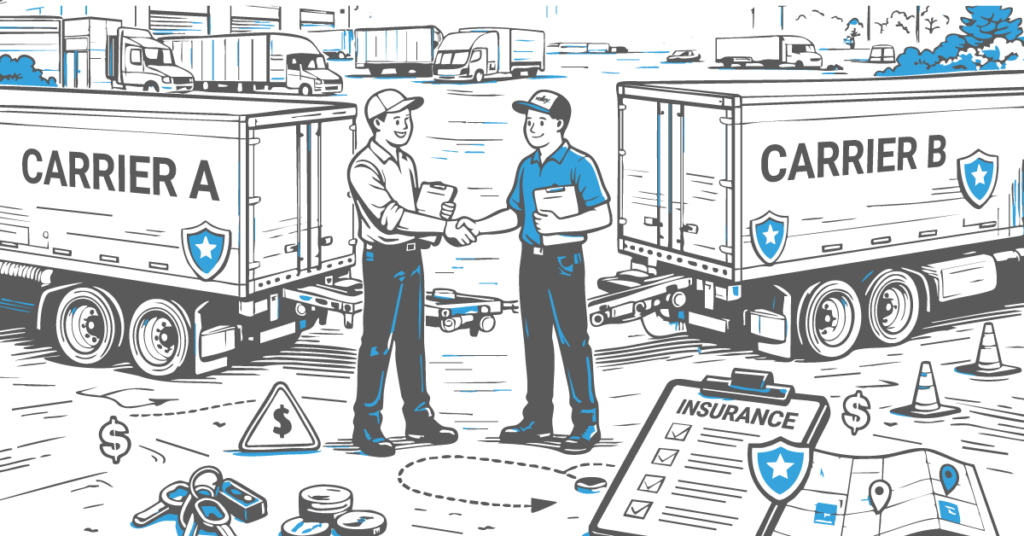
Key takeaway: Trailer swap liability in trucking refers to who bears financial responsibility for damage to a non-owned trailer while it is in your possession under a trailer interchange agreement. The moment your driver hooks up to someone else’s trailer, the physical damage coverage on that trailer does not transfer to you — you are responsible for any damage that occurs while it is in your care, custody, and control. Trailer interchange insurance exists specifically for this exposure. Any fleet or owner-operator that regularly pulls non-owned trailers under a written interchange agreement needs this coverage. Standard physical damage or commercial auto policies do not cover it.
Drop and hook is one of the most common moves in trucking. Your driver drops a loaded trailer, picks up an empty, and rolls. Clean. Efficient. Done in 20 minutes. What nobody talks about is what happens when that empty gets rear-ended at a fuel stop two states later — and whose policy responds.
Most fleet owners assume the trailer owner’s coverage handles it. It doesn’t. The instant your driver took possession, the financial liability shifted. That’s how interchange agreements work. And if your policy isn’t built for it, you’re paying out of pocket for a trailer you don’t even own.
What Is a Trailer Swap — and Why Does Liability Follow Possession?
A trailer swap, or drop and hook, happens when a trucking operation picks up a trailer owned by another party — another fleet, a shipper, a logistics company — instead of driving loaded with a trailer it owns. These arrangements are structured through trailer interchange agreements: written contracts between two authorized for-hire operations that specify the equipment being exchanged, the points of interchange, how the equipment will be used, and what compensation applies.
Federal regulations governing interchange are set out in 49 CFR Part 376, which covers both the leasing and interchange of vehicles by authorized motor carriers. Under 49 CFR § 376.31, a written interchange agreement must specifically describe the equipment, identify the points of interchange, and be signed by both parties. Once that agreement is executed and your operation takes possession of the trailer, the financial responsibility for any damage shifts to you. The trailer’s owner still carries their own policy — but that policy isn’t covering your exposure while their trailer is on your hook.
What the FMCSA Says About Interchange Agreements
The FMCSA requires that participating operations hold active operating authority to serve the commodities at the point of interchange. Traffic must move on through bills of lading issued by the originating operation, and rates charged to the shipper must remain as if no interchange had occurred. What the regulations do not do is dictate which party’s insurance pays for physical damage to the interchanged trailer. That determination comes from the interchange agreement itself — and from whether the party in possession has the right coverage in place.
Your Physical Damage Coverage Doesn’t Travel With the Trailer
This is where fleet owners get into trouble. Standard commercial auto physical damage coverage protects equipment you own. Your tractor, your trailers — the iron listed on your policy. The trailer you just hooked up from another operation isn’t on your schedule. It isn’t your property. And your physical damage policy isn’t going to respond when it takes a hit.
That’s not a gray area. It’s a hard exclusion built into how commercial auto physical damage works. The trailer owner’s policy is also not going to cover your period of possession — they didn’t give you the trailer; they gave you responsibility for it. So if the trailer is stolen at a truck stop, rear-ended at a weigh station, or catches fire at a loading dock, neither your standard policy nor theirs covers the damage during your window of possession. The gap sits squarely in the middle, and it’s big enough to cost you the full replacement value of a commercial trailer. Dry vans run $30,000 to $50,000 or more depending on age and spec. That’s an out-of-pocket number most small fleets can’t absorb in a single hit.
Trailer Interchange Insurance: The Coverage That Actually Fills This Gap
Trailer interchange insurance is a physical damage policy specifically designed to cover non-owned trailers while they are in your possession under a written trailer interchange agreement. It responds to the exposure your standard policy ignores.
You select a coverage limit — ideally equal to or greater than the replacement value of the trailers you typically run — and a deductible you can comfortably absorb. If the interchanged trailer is damaged during your window of possession, this is the policy that responds. The trailer interchange agreement itself must be in place and on file. No signed agreement, no coverage — most insurers will deny the claim outright without one.
What Trailer Interchange Insurance Covers
Trailer interchange coverage responds to physical damage caused by collision, fire, theft, vandalism, and certain weather events while the non-owned trailer is in your custody. It covers the trailer whether it is attached to your power unit or sitting in your yard or at a transfer hub — that distinction matters, and it’s a meaningful difference from non-owned trailer coverage.
It does not matter whether the trailer is loaded or empty. Coverage follows the period of your possession under the agreement, not the loaded status of the equipment.
What It Doesn’t Cover
Trailer interchange insurance covers the trailer. Full stop. It does not cover the cargo inside it — that’s your motor truck cargo policy’s job. It does not cover bodily injury or third-party property damage — that’s commercial auto liability. It does not cover mechanical breakdown, wear and tear, reefer unit failure, or temperature-related spoilage. If the interchange agreement includes a reefer trailer, you need separate reefer breakdown and cargo endorsements to cover the cold chain exposure. Trailer interchange coverage is narrow by design. Know what it does and structure the rest of your coverage package around what it doesn’t.
Trailer Interchange vs. Non-Owned Trailer Coverage — They’re Not the Same Thing
These two coverages sound like the same thing. They’re not, and confusing them creates exactly the kind of gap that shows up at claim time.
Non-owned trailer coverage extends physical damage protection to a non-owned trailer while it is attached to a covered power unit on your active policy. That’s the key word: attached. The second that trailer is uncoupled from your tractor — dropped at a facility, parked at a transfer yard, sitting on your lot overnight — non-owned trailer coverage stops. The exposure doesn’t.
Trailer interchange coverage protects the non-owned trailer for the entire period it is in your possession under the interchange agreement, whether it’s rolling down the highway or sitting staged at a dock. For fleet operations that regularly run drop and hook, or that stage interchanged trailers for any period before dispatch, non-owned trailer coverage alone leaves a real hole. The practical test: if you unhook and walk away from a non-owned trailer for any amount of time, you need interchange coverage, not just non-owned trailer protection.
A secondary difference worth knowing: trailer interchange coverage typically requires a formal written interchange agreement to be in place as a condition of coverage. Non-owned trailer coverage can sometimes apply without one — but it only responds while the trailer is on your truck. If your operation is moving toward formal interchange arrangements, talk to your broker before the agreements are signed, not after.
What Happens If You Don’t Have the Right Coverage in Place
You get a call from the trailer owner. Or from their attorney. The trailer was in your possession. The interchange agreement says you’re responsible for damage during your period of custody. And your policy doesn’t have the coverage to respond.
The most common version of this situation I see: a fleet has physical damage on their own equipment, assumes that coverage is broad enough, and never adds the trailer interchange endorsement. The first time they pull a non-owned trailer under a written agreement and something goes wrong, they find out exactly where the gap is. At that point, the only question is how much it costs.
For fleets running power-only or participating in UIIA (Uniform Intermodal Interchange and Facilities Access Agreement) arrangements — common in intermodal rail and port drayage operations — trailer interchange coverage is frequently a contractual requirement. The shipper or terminal operator will ask for it on the certificate of insurance before they let you on the yard. Getting to that point without coverage in place doesn’t just create a liability problem. It can cost you the customer entirely.
Before You Hook Up: What Your Policy Should Include
If your operation pulls non-owned trailers under any type of interchange agreement, here’s what the policy structure needs to address:
- Trailer interchange coverage with a limit that reflects the actual replacement value of the trailers you handle. If you’re regularly pulling 53-foot refrigerated trailers, your limit needs to reflect that — not a number you picked three years ago when you were running dry vans.
- A deductible you can fund without disrupting operations. A $5,000 deductible sounds fine until you’re facing a total loss on a Friday.
- Confirmation that your motor truck cargo policy covers freight in a non-owned trailer. Most do, but verify — some cargo policies are written around trailers you own or control on a permanent basis.
- A copy of every active interchange agreement on file with your broker. Insurers will ask for it at claim time. Have it before the loss, not after.
- Clarity on reefer exposure. If any interchanged trailers carry refrigerated or temperature-sensitive freight, separate endorsements are required. Trailer interchange does not cover reefer breakdown or spoilage.
One more thing worth saying plainly: some insurers won’t write trailer interchange coverage at all, or will limit it in ways that don’t match your actual operations. Working with a broker who specializes in commercial trucking risk matters here. A generalist shop may not have access to the markets that write this coverage cleanly for the kind of interchange volumes a real fleet operation runs.
If you’re not sure whether your current policy covers the trailers you’re already pulling, that’s worth a conversation before the next load. Get your coverage reviewed at Valley Trucking Insurance — we’ll look at what you have, identify the gaps, and make sure you’re not carrying an exposure nobody told you about.
Frequently Asked Questions
What is trailer swap liability in trucking?
Trailer swap liability refers to the financial responsibility a trucking operation assumes for physical damage to a non-owned trailer once it takes possession under a trailer interchange agreement. The party in possession at the time of the loss is typically responsible for repair or replacement costs.
Does my physical damage insurance cover a trailer I don’t own?
No. Standard commercial auto physical damage coverage only applies to equipment listed on your policy — equipment you own. A non-owned trailer in your possession is not covered unless you have a trailer interchange endorsement or a non-owned trailer coverage provision that applies to the situation.
What is a trailer interchange agreement and why does it matter for insurance?
A trailer interchange agreement is a written contract between two authorized for-hire operations governing the exchange of equipment. Under 49 CFR § 376.31, it must describe the equipment, identify interchange points, and be signed by both parties. For insurance purposes, the agreement is typically a required document for trailer interchange coverage to respond — no agreement on file, no coverage.
What is the difference between trailer interchange insurance and non-owned trailer coverage?
Non-owned trailer coverage only applies while the trailer is physically attached to your power unit. Trailer interchange insurance covers the non-owned trailer for your entire period of possession under the agreement — attached, unattached, staged, or parked. For drop and hook operations or any situation where trailers sit in your yard or at a facility, interchange coverage is the right tool.
Does trailer interchange insurance cover the cargo inside the trailer?
No. Trailer interchange insurance covers the trailer itself — the physical equipment. Cargo inside the trailer requires a separate motor truck cargo policy. These are two distinct coverages and one does not substitute for the other.
Who pays for a damaged trailer in a swap — the fleet that owns it or the fleet that was pulling it? Under most interchange agreements, the fleet in possession at the time of the loss bears responsibility for damage. The trailer owner’s policy does not cover the period of your custody. That’s the exposure trailer interchange insurance is built to address.
Do I need trailer interchange coverage for power-only loads?
Yes. Power-only operations — where your tractor moves a trailer owned by someone else — are exactly the situation trailer interchange coverage is designed for. Many shippers and terminal operators also require proof of trailer interchange coverage as a condition of doing business.
What coverage limit should I carry for trailer interchange insurance?
Your limit should reflect the actual replacement value of the trailers you regularly pull. If you’re running refrigerated trailers worth $60,000 or more, a $20,000 limit creates a significant out-of-pocket exposure. Review your limit any time your freight mix changes, and confirm your deductible is an amount your operation can fund without disrupting cash flow.

Smarter Coverage. Real Support. No Hassle.