🔔 Announcement: American Trucking Insurance is now a part of Valley!
See details
🔔 Announcement: American Trucking Insurance is now a part of Valley!
See details

Short-Term Leased Trucks Create Insurance Conflicts Most Fleets Don’t See Coming

Cameron Pechia / Apr 1, 2026
Reviewed by Cameron Pechia, Founder, WA Insurance License 71186
Last reviewed: 4/01/2026
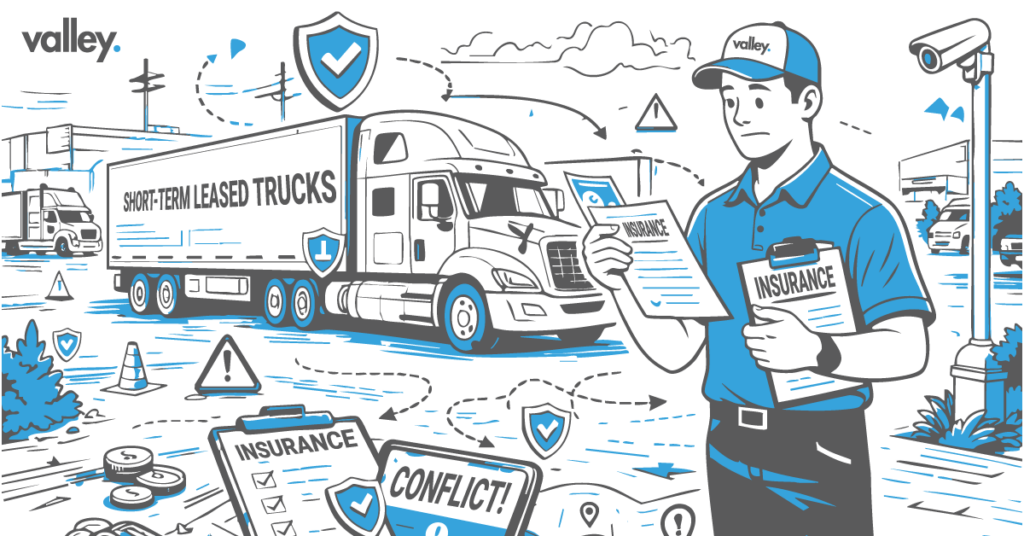
Key takeaway: Short-term leased truck insurance conflicts arise when a fleet’s existing policy doesn’t automatically extend to equipment it doesn’t own. The truck may be operating under your authority and your DOT number — but without a specific endorsement, your physical damage coverage, cargo liability, and non-trucking liability can all fall through the floor. This applies to any fleet owner or owner-operator who pulls in temporary or rented equipment to handle overflow loads, cover a down unit, or test a new lane before committing to a purchase.
You picked up a leased truck for three weeks to cover a driver whose regular unit is in the shop. You confirmed the lease, got it signed, put it in service. The load moves. Everything looks fine.
Then something happens. A fender bender at a shipper’s dock. A cargo claim. The leasing company’s insurance wants nothing to do with it because your operation was running the truck. Your policy wants nothing to do with it because the truck isn’t a scheduled unit on your policy. And now you’re standing in a gap that nobody told you existed.
This is the short-term leased truck problem. It’s not rare. It’s just not talked about until after the claim.
The Problem Nobody Reads Until There’s a Claim
Most commercial trucking policies are written around scheduled equipment — the specific trucks your operation owns and runs. Add a unit to the schedule, it’s covered. Take one off, it’s not. Simple enough when your fleet is stable.
Short-term leases break that model. You’re operating equipment you don’t own, often for a matter of days or weeks, under pressure to move freight. The lease agreement gets signed fast. The insurance question gets assumed rather than answered. And “assumed” is where the exposure lives.
The specific conflict comes down to three things. First, does your policy have a provision for non-owned or temporarily substituted equipment? Second, does the lease language require you to carry specific coverage types, and does your current policy actually meet that requirement? Third, is there a gap between when the truck enters your service and when your broker gets around to endorsing it onto your policy?
All three of those questions can have bad answers at the same time. When they do, you’re operating a truck with real liability exposure and no policy positioned to respond the way you need it to.
How FMCSA Leasing Rules Assign Liability — and Where the Gaps Live
What 49 CFR Part 376 Actually Requires
FMCSA’s leasing regulations under 49 CFR Part 376 govern how for-hire operations must handle equipment they don’t own. The core rule: there must be a written lease, and that lease must specify who is responsible for which insurance coverage on the leased equipment.
Under 49 CFR § 376.12, the lease is required to state the authorized carrier’s legal obligation to maintain insurance coverage for protection of the public — and specifically who is responsible for other coverage types, including bobtail insurance. That language matters because it means the lease document itself is supposed to answer the insurance responsibility question. If your lease doesn’t answer it clearly, you’re operating in ambiguity. If it does answer it and your policy doesn’t match, you have a compliance problem and a coverage gap running simultaneously.
The regulation also requires that the authorized carrier lessee assume complete responsibility for the operation of the equipment for the duration of the lease. Operationally, that means the truck is your problem from the moment possession transfers.
The Window Between Pick-Up and Policy Endorsement
Here’s the field-level reality: most small and mid-size fleets don’t call their broker the morning they pick up a leased unit. They call a day later, or at the end of the week, or when they get around to it. That window — even if it’s 24 hours — is unendorsed operation.
If a loss happens in that window, your policy may deny based on the equipment not being listed. The leasing company’s policy won’t respond because you had possession and control. You’re in the gap.
The fix is operationally simple but requires discipline. The leased unit gets called into your broker before it leaves the yard. Not after. Before.
Physical Damage: Who Covers the Truck You Don’t Own?
Physical damage coverage on a leased unit is one of the most misunderstood pieces of the short-term lease equation. Your own physical damage policy covers your trucks — the ones scheduled on your policy. A leased unit you don’t own is not automatically included.
Most lease agreements require the lessee (your operation) to carry physical damage coverage on the leased equipment for the duration of the lease. That’s a contractual requirement layered on top of the insurance question. If something happens to that truck while it’s in your service and you don’t have coverage for it, you owe the leasing company for the damage out of pocket.
There are a few ways to address this. Some carriers can add a blanket physical damage provision that covers temporarily operated non-owned equipment. Some will endorse the specific unit for the duration of the lease. A third option — and this one gets missed constantly — is to verify whether the leasing company’s own policy includes physical damage and whether it stays primary during your operation of the unit. That verification needs to happen before you sign the lease, not after you file a claim.
Whatever the structure, it needs to be documented. A verbal assurance from the leasing company that “they’re covered” is not coverage.
Cargo Coverage and the Care, Custody, and Control Problem
Your motor truck cargo policy covers freight in your care, custody, and control. That’s the standard language. When you’re operating a leased truck, the freight is absolutely in your care, custody, and control — so the cargo coverage question isn’t really about the truck. It’s about whether your cargo policy has any exclusions or conditions that affect loads moved in non-scheduled or non-owned equipment.
Some cargo policies have language that limits coverage to specifically described vehicles. Others have broader provisions. The problem is that most fleet owners don’t know which kind they have until a claim gets filed and the insurance company starts reading the policy language out loud.
If your cargo policy requires the freight to be moved in a described vehicle and the leased unit isn’t on the list, you have a gap. If your policy has a substitution clause that allows temporary replacement equipment, you may be fine — but that clause needs to be confirmed, not assumed. FMCSA’s Insurance Filing Requirements make clear that coverage must remain continuously active and adequate for all operating authority. A cargo gap on a leased unit is a gap against your authority, not just a policy technicality.
Bobtail and Non-Trucking Liability on a Leased Unit
Bobtail coverage applies when a truck is operated without a trailer and outside of a dispatch — typically moving the unit to or from a load, or between jobs. Non-trucking liability is the broader version: it applies when a truck is used for purposes not under dispatch or not in the course of for-hire operations.
On a leased unit, both of these raise a specific question: whose policy responds when the truck is moving without cargo, outside of an active haul?
Under 49 CFR § 376.12, the lease agreement is supposed to identify who carries bobtail coverage. If it says the lessee (you) is responsible, you need a policy provision that covers a non-owned unit in that scenario. Standard bobtail and non-trucking liability policies are often written to cover only units listed on the policy. A leased unit that isn’t specifically added may be excluded.
This is a scenario where the lease language and your policy language need to be read side by side. Two documents. Both matter. If they don’t align, you have the kind of gap that produces a denied claim and a very long conversation with your broker about why nobody caught it.
The Endorsement Question Your Broker Should Already Be Asking
When you call to add a leased unit, a broker who knows trucking asks three things immediately: Is this a short-term or long-term lease? Who holds the title? And what does the lease say about insurance responsibility?
Those three questions narrow down whether the unit needs to be formally added as a scheduled vehicle, handled under a non-owned auto provision, or covered with a separate endorsement for the lease period. A broker who doesn’t ask those questions — or who just says “send over the VIN and we’ll add it” — is processing paperwork, not managing your risk.
The distinction matters because the wrong endorsement type can leave gaps. Adding a leased unit as a permanent scheduled vehicle when it’s a 30-day lease creates administrative cleanup problems and may affect your rating at renewal. Treating it as non-owned auto when the lease assigns you full insurance responsibility misaligns your coverage with your contractual obligation. The structure has to match the actual arrangement.
FMCSA’s minimum financial responsibility requirements under 49 CFR Part 387 set the floor for public liability — confirm current limits at the eCFR (verify current limit). Your policy needs to meet those requirements on the leased unit from the moment your authority covers it, not from when your broker gets around to processing the paperwork.
What to Do Before the Leased Truck Leaves the Yard
The fix for most of these conflicts is procedural, not complicated. It requires discipline at the point of lease, not after.
Before the leased truck enters service:
- Read the lease insurance requirements clause. Know who is responsible for liability, physical damage, cargo, and bobtail before you sign.
- Call your broker before possession transfers. Confirm whether your existing policy covers the unit as a non-owned vehicle or whether a specific endorsement is needed.
- Verify the leasing company’s policy. Ask whether their physical damage coverage stays in effect during your operation, and get that in writing.
- Confirm your cargo policy’s vehicle description requirements. If the policy requires described vehicles, get the leased unit added before it moves freight.
- Document the lease start and end dates. These define the coverage period. Your broker needs them to structure the endorsement correctly.
None of this takes more than a few phone calls. The alternative is discovering the gap during a claim — which is the worst possible time to be reading policy language for the first time.
If you’re running leased equipment and haven’t had someone walk through how your current policy handles it, that’s worth doing now. At Valley Trucking Insurance, we write coverage for non-standard and temporary equipment situations — and we look at the lease language, not just the VIN. Get a coverage review at Valley Trucking Insurance before the next unit hits your yard.
Frequently Asked Questions
Does my commercial trucking policy automatically cover a short-term leased truck?
Not necessarily. Most commercial trucking policies cover specifically scheduled equipment. A leased unit may not be covered unless your policy has a non-owned auto provision or the unit is specifically endorsed onto the policy before it enters service.
Who is responsible for insurance on a leased truck — the fleet or the leasing company?
It depends on the lease. Under 49 CFR § 376.12, the lease agreement must specify who is responsible for each type of insurance coverage. Read the lease before you sign it.
What happens if a leased truck is in an accident before my broker adds it to my policy?
Your policy may deny the claim because the unit wasn’t scheduled. The leasing company’s policy may also deny because you had possession and control. The gap between pick-up and endorsement is real exposure — which is why the call to your broker needs to happen before the truck moves.
Does my cargo insurance cover freight hauled in a leased truck?
It depends on your policy language. Some motor truck cargo policies limit coverage to specifically described vehicles. If the leased unit isn’t on the list, freight moved in that truck may not be covered. Confirm with your broker before the first load.
What is bobtail coverage and why does it matter on a leased unit?
Bobtail coverage applies when a truck operates without a trailer and outside of dispatch — moving to or from a load, or between jobs. On a leased unit, you need to confirm whether your bobtail policy extends to non-owned or non-scheduled vehicles. Many do not by default.
How long does it take to add a leased truck to my policy?
For most operations, a broker can add a unit same-day. The issue isn’t processing time — it’s the gap created when fleets take possession before calling their broker. Make the call before the truck leaves the yard.
What does 49 CFR Part 376 require for leased equipment insurance?
49 CFR Part 376 requires a written lease that specifies the authorized carrier’s obligation to maintain public liability insurance and identifies who is responsible for all other coverage types on the leased unit. The carrier assumes full operational responsibility for the equipment during the lease period.
Can an owner-operator lease a truck from a leasing company and operate it under their own authority?
Yes, and when they do, all of the same insurance responsibility questions apply. The owner-operator operating under their own MC authority is the authorized carrier under 49 CFR Part 376 — which means the insurance obligations fall on them, not the leasing company, for the duration of the lease.

Smarter Coverage. Real Support. No Hassle.