🔔 Announcement: American Trucking Insurance is now a part of Valley!
See details
🔔 Announcement: American Trucking Insurance is now a part of Valley!
See details

Parking Lot Accidents and Who Pays: Carrier vs Shipper Liability in Trucking

Cameron Pechia / Jun 10, 2026
Reviewed by Cameron Pechia, Founder, WA Insurance License 71186
Last reviewed: 6/02/2026
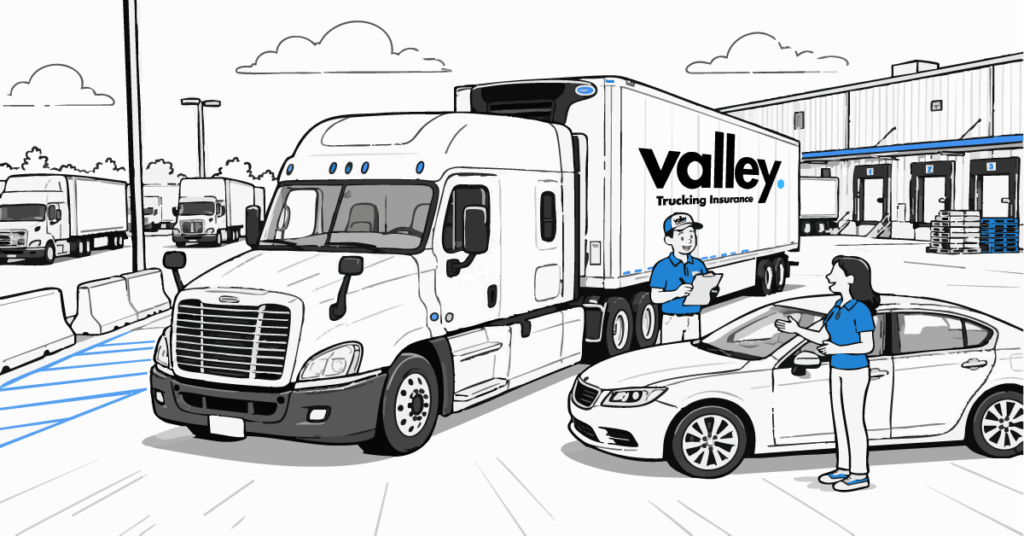
Key takeaway: Parking lot accident liability trucking claims almost never settle the way drivers expect. A parking lot crash usually isn’t a DOT-recordable accident under 49 CFR 390.5, which sounds like good news. It isn’t. It means there’s no police report, no clear fault assignment, and your insurance company has to figure out who pays from scratch. Liability typically lands on the at-fault driver’s auto policy, but the shipper, property owner, or another fleet can share the bill if their yard, their loader, or their employee caused or contributed to the wreck. This guide covers who pays in every common scenario, which policy on your stack actually responds, and the documentation that decides whether your claim gets paid or denied.
A truck stop in the middle of the night. A shipper yard at 4 a.m. before the gates open. A receiver’s back lot where three trucks are stacked waiting for a dock. That’s where most of your trucks get hit. Not on the interstate.
And those are the claims that turn into a fight.
Why parking lot accidents are the most contested claims in trucking
Parking lot incidents make up a huge share of the property damage claims I see come across my desk, and they’re the hardest ones to close. There’s a reason for that. Most of the rules drivers know — right of way, posted speed, lane discipline — don’t formally apply on private property. A parking lot accident on private property is governed by common law negligence principles rather than formal traffic law, which means there’s no clean statute to point at when assigning fault.
Police often won’t even show up to a non-injury parking lot crash, and if they do, they might not file an official accident report. This can complicate the claims process, as insurance adjusters often rely on police reports to determine fault. You end up with two drivers, two stories, and a damaged truck. The fleet that documents the scene best usually wins.
The other reason these claims drag: parking lot wrecks happen at low speed, but the repair bills don’t behave like low-speed wrecks. A clipped fairing, a torn mirror assembly, a cracked sleeper corner — those parts run real money on a modern tractor. The National Safety Council reports that approximately 50,000 accidents involving motor vehicles occur every year in parking lots and garages, with over 60,000 injuries and 500 fatalities. Trucking takes a disproportionate slice of that.
Is a parking lot crash even a DOT-reportable accident?
Most of the time, no. And that surprises people every time.
Under 49 CFR 390.5, an accident is only DOT-reportable if it involves a commercial motor vehicle operating on a highway in interstate or intrastate commerce and it results in a fatality, an injury requiring immediate medical treatment away from the scene, or a vehicle being towed away with disabling damage. A truck sitting still in a private lot, or rolling at 4 mph between rows, doesn’t meet the “operating on a highway” piece for most insurers and most enforcement officers.
That sounds like a relief — no recordable, no CSA hit, no Accident Register entry. In practice it cuts the other way. Because there’s no DOT report, no official preventability review, and often no police report, the only documentation that exists is what you and your driver create at the scene. When accidents happen on private property with no police reports, opposing trucking companies and their insurance companies may deny the claims. Your driver’s word against their driver’s word.
Important caveat: a parking lot vehicle can still be a CMV under FMCSA’s definition if it meets weight and commerce tests. The vehicle’s classification doesn’t change. The location of the crash is what knocks it out of the recordable bucket.
Who pays when one of your trucks hits another truck in a yard?
Default answer: the at-fault driver’s employer pays through their commercial auto liability policy. That’s it. The trailer load, the dispatch status, the location — none of that changes the basic rule. If your driver hit the other truck, your liability coverage responds for the damage to the other unit and any injuries.
What changes is whether your driver was actually “your driver” at the moment of impact.
If your driver was under dispatch — even just parked at a shipper waiting to load — your primary commercial auto liability is in play. If your driver was an owner-operator leased to your authority and was under your dispatch, same answer. If your driver was off-duty, parked overnight, and backed into another truck while pulling out for personal reasons, you may be looking at a non-trucking liability or bobtail claim instead, and the answer depends entirely on the lease language and the policy’s “in the business of” definition.
This is the part that destroys claims for owner-operators. Coverage lives and dies by the definitions in your policy and lease: “under dispatch,” “business use,” and “non-trucking.” Those definitions vary by insurer and by contract. A wreck in a truck stop lot at 2 a.m. between loads can land in three different policies depending on how the lease reads and what the dispatch log shows.
When the shipper or property owner shares the bill
The shipper, receiver, or yard owner can absolutely be on the hook for a parking lot accident in your fleet — but only when their negligence as the property owner caused or contributed to the wreck. This is premises liability, not auto liability, and it lives on the shipper’s general liability policy, not theirs.
Premises liability basics
Property owners and businesses have a duty to keep their premises reasonably free from hazards for visitors. They may be held liable in a premises liability claim for injuries caused by hazardous conditions like potholes, poor lighting, inadequate security, and unclear signage. That standard applies to trucking yards the same as a Walmart parking lot. If your driver hit a pothole big enough to deflect his steer tire and clip the next truck over, the shipper’s property condition is in the conversation.
When the yard layout itself is the problem
I’ve seen yards where two trucks can’t physically pass each other in the same aisle without one of them coming within inches of mirrors. I’ve seen receivers where dock doors are set so close together that backing in without clipping the next trailer takes a miracle. For example, the property owner might share responsibility if a pothole or poor lighting contributed to an accident. Same logic for unsafe layout, blocked sightlines, or a lumper crew directing a driver into a parked unit.
When this hits a claim, the shipper’s insurer fights it hard. They’ll argue that the driver should have refused to back in, called for help, or driven around. Sometimes they win that fight. Sometimes the photos of the layout settle it the other way before it goes to litigation. The point: don’t assume your fleet is the only entity that can be made to pay.
Carrier vs shipper liability: how fault actually gets divided
Two separate liability frameworks are sitting on top of one parking lot crash. Auto liability — yours and the other fleet’s — covers driver negligence. Premises liability — the shipper’s, the truck stop’s, the property owner’s — covers unsafe conditions on the lot. They can both pay. They can both deny. They can be in conflict, and they usually are.
Here’s how the split typically shakes out in real claims:
| Scenario | Primary liability | Secondary liability |
| Your driver backs into a parked truck at a shipper | Your auto liability | Possibly the shipper if layout/lighting was a factor |
| Lumper directs your driver into a column or another unit | Shipper’s general liability | Your driver if he had clear visibility and ignored it |
| Your driver is sideswiped by another carrier’s truck pulling out | Other fleet’s auto liability | Shipper if poor signage or layout contributed |
| Driver slips on ice walking around the truck at a truck stop | Property owner’s general liability | Workers’ comp (if your driver) |
| Your trailer is damaged by a forklift while spotted at receiver | Receiver’s general liability (or their forklift coverage) | Possibly your trailer interchange policy depending on terms |
What this means for you as a fleet owner: don’t accept the first liability assignment your adjuster gives you. If a shipper’s yard or a property owner’s negligence contributed to the wreck, you have a subrogation play. Push your adjuster to pursue it. Most of the time they will if you bring the documentation.
When cargo is involved, separate rule. It is the responsibility of the motor carrier and the driver to ensure that any cargo aboard a vehicle is properly loaded and secured. Even if the shipper loaded a sealed trailer and your driver never opened it, your fleet still owns cargo securement liability if it shifts and causes damage. “The shipper loaded it” is not a defense.
What about damage to your own truck or trailer?
Your liability policy doesn’t pay for your own equipment. That’s a common misread.
Physical damage coverage — collision and comprehensive — is what pays to fix your tractor and trailer. If your driver was at fault, your physical damage coverage pays after your deductible, and your liability pays the other fleet. If the other fleet was at fault, you make the claim against their liability and (ideally) skip your own physical damage deductible entirely.
The trouble is when nobody can prove who hit whom. Two trucks in a row, both with damage on the same side, no cameras, no police report, no witnesses. The fight that follows is the reason I tell every fleet owner to spec dash cameras on every unit. A $400 camera settles a $14,000 dispute in 30 seconds.
The dispatch-status trap that gets owner-operator claims denied
If you’ve got owner-operators leased to your authority, this section is for them. Read it carefully.
A leased owner-operator usually has three policies stacked on his tractor: the motor carrier’s primary liability (yours), a bobtail or non-trucking liability policy of his own, and physical damage on the truck. Which one responds to a parking lot claim depends entirely on dispatch status at the moment of impact.
Bobtail insurance covers trucks that are driving without trailers, but are still under dispatch. It commonly covers trucks that are en route to a pick-up location, or recently dropped off a load. NTL covers trucks that are driven “off duty,” and are no longer under dispatch. For example, a non-trucking liability policy would cover a truck driver who stops at the grocery store between dropping off their last load and going home for the day and is involved in an accident in the store parking lot.
The trap: drivers think “no trailer = bobtail = I’m covered” or “I’m at a truck stop overnight = personal use = NTL covers me.” Neither one is automatic. Dispatch messages and lease terms can still put you in business use even when the ELD says off-duty. If the carrier’s dispatch system shows the driver was instructed to be at that truck stop overnight in anticipation of a 6 a.m. load, the NTL carrier will argue business use and deny.
Cameron’s field observation: the cleanest parking lot claims I see from leased owner-operators are the ones where the driver pulled out his phone the second the wreck happened and screenshotted his ELD status, his Qualcomm or Trucker Path messages, and the last dispatch text. The dirtiest claims are the ones where the driver said “I’m covered, I wasn’t dispatched” and didn’t capture any of it. Three weeks later the adjuster asks for proof, and there’s nothing.
How to document a parking lot incident so your claim survives
Run this checklist with every driver in your fleet. It costs nothing and pays off on the first claim.
- Stop and stay. Driver does not move the truck unless instructed by police or a property manager. Moving the truck destroys the scene.
- Photograph everything. Both trucks, both license plates, both DOT numbers, all damage, the surrounding lot, the lighting, any potholes or hazards within 50 feet, any signage, any painted lane markings.
- Wide shots first, then close-ups. Adjusters need context. A close-up of a dented fairing tells them nothing about who was where.
- Get the other driver’s name, CDL, employer, DOT, and insurance card. Photograph the documents. Don’t write it down.
- Call the police anyway. Even if they won’t write a report, the dispatch log creates a timestamp. Sometimes they do come. Ask the police officer to write a report. Don’t be surprised if he or she won’t write the bad driver a ticket. Many times, police only help with an exchange of information between drivers if the accident happened on private property.
- Capture witnesses. Lumpers, other drivers in the lot, guards at the gate. Get a name and number, not just “the guy in the blue hat saw it.”
- Photograph or screenshot your dispatch status. ELD, Qualcomm, dispatch text messages. Time-stamped. Right now, before you move.
- Pull dash cam footage immediately. Most cams overwrite within 24-72 hours.
- Notify your insurance agent the same day. Not the carrier. Your agent. They drive the claim file.
- Write a narrative in your own words within 24 hours. Memory degrades fast. Do it the night of the wreck.
That checklist is the difference between a 30-day claim and a six-month claim. I’ve seen both.
How to keep parking lot claims from wrecking your loss runs
Parking lot incidents are the silent killer of fleet insurance pricing. They don’t show up on a CSA score, they don’t trigger DOT review, and they look small on paper — $4,000 here, $7,000 there. But your loss runs see every single one. And when your renewal hits, that’s the document underwriters are looking at.
Three or four small parking lot claims in a policy year can shift a fleet from preferred pricing into a substandard market. I’ve watched it happen. The fix isn’t to hide claims or to eat them out of pocket — that creates its own problems. The fix is to drive the frequency down with driver training on backing, yard awareness, and documentation. And to make sure your insurance program is built so the right policy responds to the right loss, every time.
If you’re not sure whether your current program has the right layers — primary auto liability, physical damage, NTL/bobtail for owner-operators, trailer interchange, and a general liability tie-in for yard operations — that’s exactly the kind of review a specialized trucking agent should be running for you at every renewal. If your broker isn’t asking how often you’re parked at shipper yards, how many of your drivers are leased owner-operators, and how often you swap trailers at receivers, they’re not pricing your real risk. Get a coverage review and a quote at Valley Trucking Insurance and we’ll walk every layer of your policy stack against your actual operation.
FAQ
Is a parking lot accident a DOT-recordable accident?
Usually no. 49 CFR 390.5 requires the commercial motor vehicle to be operating on a highway in interstate or intrastate commerce. Most parking lot, truck stop, and shipper yard crashes don’t meet that definition, so they don’t go on your Accident Register and don’t hit CSA. They do still hit your loss runs.
Who is liable when a driver backs into another truck at a shipper?
The backing driver’s employer is the default at-fault party, paid through their commercial auto liability policy. The shipper can share liability if the yard layout, lighting, or a lumper’s direction contributed to the crash. Document everything at the scene to support a subrogation claim.
Does my commercial auto policy cover a parking lot accident?
Yes, if your driver was under dispatch or operating in the business of the fleet at the time. If your driver was off-duty and using the truck for personal reasons, the claim may shift to a non-trucking liability or bobtail policy — depending on the policy’s “in the business of” language and your lease terms.
Can a shipper or property owner be sued for a parking lot truck accident?
Yes, under premises liability. If unsafe conditions — potholes, poor lighting, blocked sightlines, inadequate signage, ice or oil hazards — caused or contributed to the wreck, the property owner’s general liability policy can be on the hook. Photographic documentation of the scene is what makes or breaks this claim.
Why won’t the police come to a parking lot accident?
Because private property accidents often fall outside formal traffic law jurisdiction. Officers may respond for injuries but frequently won’t file a report for property-damage-only incidents on private lots. Call anyway — the dispatch log creates a timestamp that helps your claim.
What’s the difference between bobtail and NTL coverage for a parking lot wreck?
Bobtail covers a leased owner-operator’s truck without a trailer while still under dispatch (between loads). Non-trucking liability covers off-duty, personal use entirely outside dispatch. A parking lot crash at a truck stop while waiting for the next dispatch text can fall in either policy — or neither — depending on the lease and the policy definitions.
Does cargo securement liability still apply if my driver was parked? Yes. Under 49 CFR 392.9, the motor carrier and driver remain responsible for proper cargo securement throughout the trip — including stops at shippers, receivers, and truck stops. If cargo shifts in the trailer during a parking lot incident and damages another vehicle, that’s your liability.
How long do parking lot claims affect my fleet insurance pricing?
Most insurers look at three to five years of loss history at renewal. Frequency matters more than severity — three small parking lot claims weigh heavier in underwriting than one larger highway loss in many cases. Driver training on backing and yard awareness is the most effective frequency reduction you can do.

Smarter Coverage. Real Support. No Hassle.