🔔 Announcement: American Trucking Insurance is now a part of Valley!
See details
🔔 Announcement: American Trucking Insurance is now a part of Valley!
See details

Nuclear Verdicts in Trucking: What a $10M+ Judgment Actually Means for Your Insurance

Cameron Pechia / Jun 10, 2026
Reviewed by Cameron Pechia, Founder, WA Insurance License 71186
Last reviewed: 6/10/2026
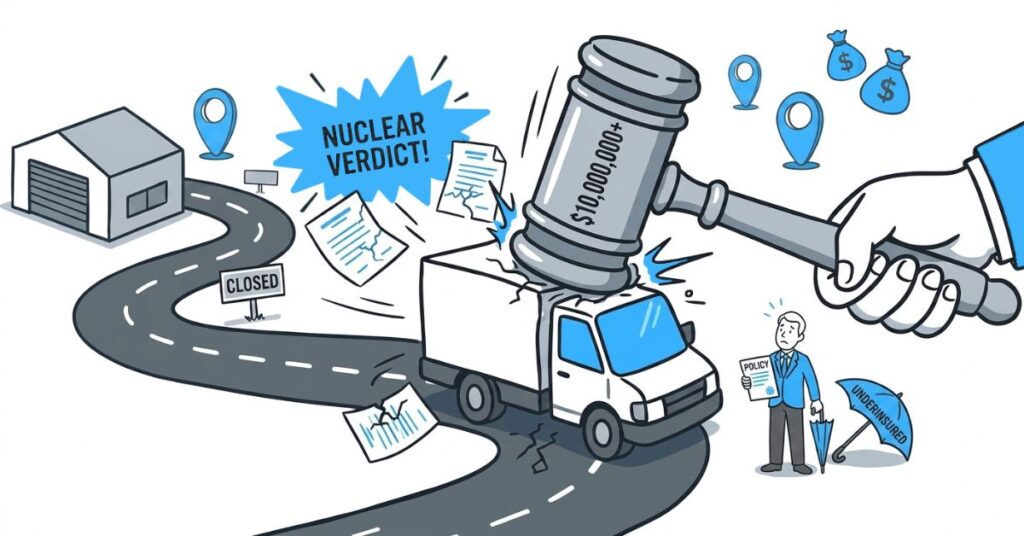
Key takeaway: A nuclear verdict is a jury award of $10 million or more against a trucking company. They’re no longer rare. The median nuclear verdict in trucking sits around $36 million, and verdicts above $50 million have grown sharply in the last few years. For fleet owners, nuclear verdicts trucking insurance exposure is the gap between your liability limits and what a jury can actually award — and once a verdict exceeds your policy, the difference comes out of your business. This guide explains what $10M+ judgments actually do to your coverage, why premiums keep climbing across the board, and the specific moves fleet owners are making before one lands on them.
The number on the renewal isn’t going up because your safety record got worse. It’s going up because a jury in Georgia awarded $462 million against a trailer manufacturer in 2024, and your insurance company has to price the risk that the next one lands on a fleet that looks like yours.
That’s the part most renewal conversations skip.
What is a nuclear verdict in trucking?
A nuclear verdict is a jury award of $10 million or more in a single case. The term originated in the trucking and commercial transportation space because that’s where these verdicts hit hardest and most often. The American Transportation Research Institute (ATRI) tracks them as a distinct category because their behavior — frequency, size, geographic concentration — doesn’t follow normal litigation patterns.
The $10 million threshold isn’t arbitrary. It’s the point where a typical for-hire fleet’s primary liability policy gets exhausted and the judgment starts eating into excess layers, business assets, or both.
Why $10 million is the threshold
Most for-hire interstate fleets carry primary liability between $750,000 (the federal minimum for general freight) and $1 million (the practical minimum to get loads tendered by most brokers). FMCSA financial responsibility rules in 49 CFR Part 387 set the floor. Excess and umbrella layers stack on top, usually in $1M to $5M increments. A $10 million verdict blows through primary and into excess. A $36 million verdict — the median — blows through most fleets’ excess tower entirely.
How often these awards actually happen
This is the part fleet owners underestimate. ATRI’s research found that the number of trucking verdicts over $1 million grew 335% between the 2006-2009 window and the 2012-2019 window. Verdicts above $10 million roughly doubled in the same period. More recent data shows the trend accelerating: nuclear verdicts against corporations rose 52% in 2024 alone, with the median jumping to $51 million.
That’s not a black swan. That’s a baseline shift.
What a $10M+ judgment actually does to your insurance
A nuclear verdict doesn’t just trigger a payout. It restructures your insurance situation in a way most fleet owners don’t see coming until they’re inside it.
Primary liability gets exhausted fast
If you carry $1 million in primary liability and a jury awards $25 million, the first million is paid by your primary carrier (insurance company) and you’ve now used up that layer entirely. Your primary policy is, for practical purposes, done for that occurrence. The remaining $24 million has to come from somewhere — and that’s where the structure of your tower matters more than the dollar amount of any single policy.
I’ve seen fleet owners with strong safety records and clean MVRs sit across from an adjuster realizing they have $4 million in excess on a $19 million verdict. The carriers all paid. The math still didn’t work.
Excess and umbrella layers do the real work
Excess liability is what catches the verdict above your primary. A typical mid-size fleet might carry $1M primary plus $4M excess for a $5M total tower. That sounds like a lot until the verdict is $36 million. The gap — $31 million in that scenario — becomes a business problem, not an insurance problem.
Some fleets layer multiple excess policies from different carriers (insurance companies) to build towers up to $25M, $50M, or higher. The structure matters. So does whether each layer “follows form” — meaning it covers the same things your primary covers under the same terms.
Where the gap usually opens up
Three places, almost every time:
- Insufficient total tower height — the fleet has limits but not enough of them
- Non-follow-form excess — the excess layer excludes something the primary covered, leaving a vertical gap in the tower
- Aggregate limit exhaustion — multiple claims in a policy period burn through aggregate limits, leaving thinner coverage for the next loss
Most fleets don’t find these gaps until they file. By then it’s a litigation problem, not a coverage problem.
Why nuclear verdicts are driving premiums on every fleet
Even fleets that have never had a serious loss are paying for nuclear verdicts. Here’s why.
Insurance pricing is built on expected losses across a pool of insureds. When the upper tail of that loss distribution gets fatter — meaning the worst-case outcomes get worse — the price of the entire pool goes up. ATRI documented that the average size of trucking verdicts above $1 million jumped from $2.3 million in 2010 to $22.3 million in 2018. That’s a 967% increase. Inflation over the same period averaged 1.7% per year.
Your premium isn’t pricing your individual risk. It’s pricing your share of that distribution.
ATRI also reports auto liability premiums for trucking have grown nearly 38% per mile in the past decade. The Owner-Operator Independent Drivers Association (OOIDA) has flagged nuclear verdicts as a direct threat to small carrier solvency, noting that for owner-operators and small fleets, litigation risk now affects insurance availability — not just price.
In plain terms: some fleets aren’t getting non-renewed because they got worse. They’re getting non-renewed because their size and operation don’t fit what underwriters are willing to write at any price.
What the federal minimum actually covers (and why it doesn’t)
The FMCSA minimum for general freight interstate carriers is $750,000 combined single limit. For household goods and certain other commodities it’s lower. For hazmat and passenger operations it ranges from $1 million up to $5 million depending on what’s hauled.
The federal minimum was set decades ago and has not been raised to keep pace with medical inflation, jury award trends, or the size of modern verdicts. A 2014 FMCSA notice of proposed rulemaking acknowledged this gap but the rule was never finalized. So the legal floor remains the same while the ceiling on what a jury can award has effectively no limit.
If your only liability coverage is the federal minimum, you are not covered for the actual exposure of modern trucking. You are covered for the exposure of trucking as it looked in the 1980s.
The coverage moves fleet owners are making right now
This is where the conversation gets practical. Here’s what we’re seeing fleet owners do before a nuclear verdict lands on them.
Reviewing your excess layer
The single most common gap I see isn’t in primary liability. It’s in excess. Fleets carrying $1M primary and $1M excess — a $2M total tower — are dramatically underinsured against the current verdict environment. Even $5M total is thin. Mid-size fleets are increasingly stacking towers to $10M, $15M, or $25M. The cost of going from $5M to $10M is rarely double. It’s often a much smaller incremental premium because the upper layers see far fewer claims.
Action: Ask your broker for a quote on $5M, $10M, and $15M total tower options. Compare the incremental cost. The number usually surprises people.
Checking your MCS-90 separately
The MCS-90 endorsement is a federal filing that guarantees payment to injured members of the public up to your filed limits. It is not insurance coverage in the normal sense — it’s a federal financial responsibility backstop, and your insurance company has the right to seek reimbursement from you for anything they pay under it.
Fleet owners often confuse the MCS-90 with broad coverage. It isn’t. If you’re operating under your own authority, you need to know exactly what your policy covers versus what the MCS-90 is on the hook for. They’re not the same money.
Documenting your safety program before you need it
Plaintiff attorneys use a tactic called “reptile theory” to frame fleets as reckless and indifferent to public safety. The defense against it is documentation — driver training records, hours-of-service compliance logs, vehicle maintenance files, hiring criteria, and the safety policies you actually enforce.
ATRI’s research found three categories of negligence where defendants tend to win at trial: situations involving ambiguity, subjective judgment, or facts that aren’t clear-cut. The fleets that win those cases are the ones that can produce paper. The fleets that lose are the ones that can’t.
This isn’t insurance advice. It’s loss-prevention advice. But it directly affects whether your insurance company can defend you instead of settling.
State-by-state: where the risk is highest
Geography matters more than most fleet owners realize. ATRI’s forensic analysis identified California, Georgia, and Florida as the states with the highest median verdicts — what the industry calls “judicial hellholes.” A fleet domiciled in a low-risk state can still face a nuclear verdict if an accident happens in one of these jurisdictions.
A handful of states have moved on tort reform in response:
- Iowa capped non-economic damages in commercial vehicle cases at $5 million in 2023 (SF 228)
- West Virginia enacted a similar $5 million non-economic damages cap in 2024 (SB 583)
- Texas passed HB 19 in 2021 limiting some reptile-theory tactics, with follow-up appellate decisions in 2023 tightening the evidentiary basis for pain-and-suffering awards
- Florida signed broad tort reform in 2023 affecting trucking litigation
These reforms help, but they don’t help everywhere. And they don’t cap economic damages — which on a catastrophic injury can run into the tens of millions on their own.
If you run interstate, your exposure follows your trucks. A reform in Iowa doesn’t help you when the crash happens in Georgia.
What to do if you’re underinsured and you know it
If you’ve read this far and you’re realizing your tower is thin, here’s the practical sequence:
- Pull your declarations pages — primary, excess, and any umbrella
- Add up your total tower height in a single occurrence
- Compare that number to $36 million (the current median nuclear verdict in trucking)
- If your tower is less than half that number, you have an exposure problem worth addressing this renewal cycle, not next year
This isn’t fear-mongering. It’s the math your insurance company is doing on every renewal, and it’s the math the plaintiff bar is doing when they decide whether your operation is worth pursuing in litigation.
We help fleet owners run this exact review every week — looking at your tower structure, your MCS-90, your excess follow-form language, and the realistic exposure of your operation against current verdict trends. If your renewal came back higher than expected and your broker didn’t explain why, or you’re not sure what your tower actually covers above primary, we can walk through it with you. Start with a coverage review at Valley Trucking Insurance and we’ll go from there.
FAQ
What is considered a nuclear verdict in trucking?
A nuclear verdict is a jury award of $10 million or more against a defendant in a single case. In trucking, these are typically wrongful death, catastrophic injury, or major property damage cases. ATRI defines and tracks them at the $10M threshold, with “thermonuclear” verdicts above $100 million now a separate category.
How common are nuclear verdicts in trucking right now?
More common than they were even five years ago. Nuclear verdicts against corporations rose 52% in 2024, and the median nuclear verdict in trucking sits around $36 million. Verdicts above $50 million have grown sharply since 2020.
What is the FMCSA minimum liability for trucking?
$750,000 combined single limit for most for-hire interstate freight operations under 49 CFR Part 387. Hazmat and passenger operations range from $1 million to $5 million depending on what’s hauled. The federal minimum has not been raised to reflect modern verdict sizes.
Will my insurance cover a $10 million verdict against my trucking company?
Only if your total liability tower — primary plus excess plus umbrella — adds up to at least the verdict amount. If your tower is $5 million and the verdict is $25 million, your insurance pays $5 million and your business is on the hook for the rest, subject to appeals and post-trial motions.
What is the MCS-90 endorsement and does it protect me from nuclear verdicts?
The MCS-90 is a federal financial responsibility endorsement that guarantees payment to injured members of the public up to your filed limits. It is not the same as broad liability coverage, and your insurance company has the right to seek reimbursement from you for what they pay under it. It does not protect your business assets in a nuclear verdict scenario.
How much liability coverage should a small fleet carry?
There is no universal answer, but mid-size fleets running interstate are increasingly building towers of $5M to $25M depending on operation, cargo, and lanes. The right number is the one that reflects your actual exposure against current verdict trends — not the federal minimum.
Why are my trucking insurance premiums going up if I haven’t had a claim?
Because pricing reflects the entire risk pool, not just your individual record. Nuclear verdicts and rising medical costs have made the upper tail of trucking losses much worse, and every insured pays a share of that.
Can a fleet survive a nuclear verdict if it has good insurance?
Yes, if the tower height matches the verdict and the excess layers follow form properly. Fleets that get hit with a verdict above their tower face business assets at risk, possible appeals, and sometimes structured settlements. The fleets that survive cleanly are the ones who built the tower before they needed it.

Smarter Coverage. Real Support. No Hassle.