🔔 Announcement: American Trucking Insurance is now a part of Valley!
See details
🔔 Announcement: American Trucking Insurance is now a part of Valley!
See details

Filing for Your Own MC Number? Here’s What Insurance Will Cost in Year One

Cameron Pechia / Jun 19, 2026
Reviewed by Cameron Pechia, Founder, WA Insurance License 71186
Last reviewed: 6/19/2026
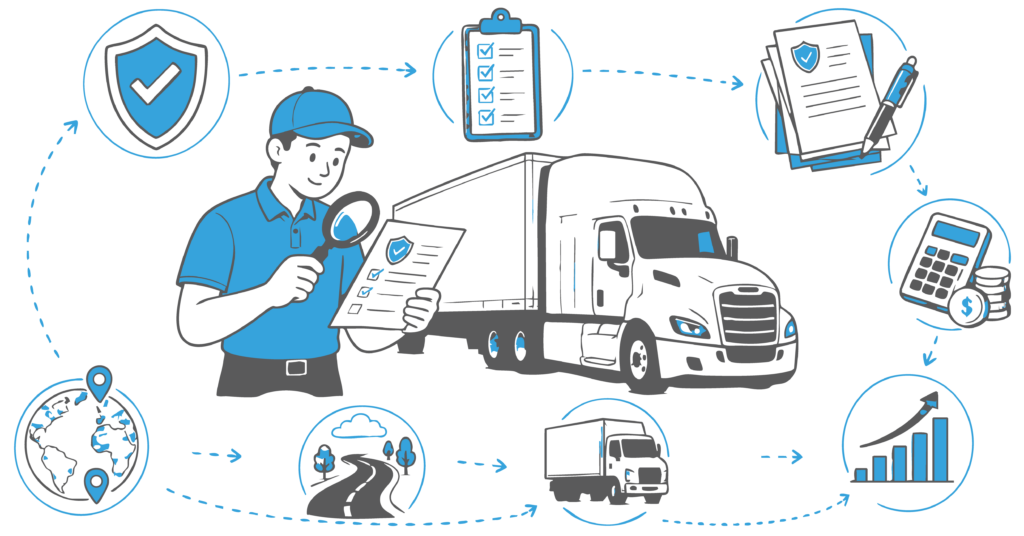
Key takeaway: New authority trucking insurance cost in year one typically runs $14,000 to $25,000 for a single-truck owner-operator running general freight, with the top end going past $30,000 in heavy-litigation states or with newer equipment. That number is higher than what veterans pay because underwriters have no loss runs to price against and the federal new entrant safety audit hasn’t cleared yet. This applies to anyone filing for their own operating authority (what most drivers still call an MC number) and running interstate for hire.
You filed for your own authority. Maybe the truck is already sitting in the lot. Then the insurance quote came back and the number was nothing close to what your buddy with five years under his own authority pays. That gap is not a mistake. It is exactly how the underwriting world prices a brand-new operation, and it lasts roughly 12 months.
Here is what that first year actually looks like, broken down by line item, and what you can do to keep the number from being worse than it has to be.
What new authority trucking insurance actually costs in year one
For a single-truck owner-operator running general freight under their own authority in 2026, year-one all-in insurance lands between $14,000 and $25,000 a year. Heavy-litigation states (Florida, Louisiana, Georgia, Texas, parts of California), newer equipment, longer radius, and certain commodities push that number higher. Some new authorities are paying $28,000 to $35,000 in their first year right now.
That total includes primary auto liability, motor truck cargo, physical damage on the truck, and general liability. It does not include non-trucking liability, occupational accident, or workers comp if your state requires it. Add those and a realistic year-one budget is closer to $16,000 to $28,000.
Most new authorities finance the premium with 20-25% down and 10 monthly payments. A typical down payment in the first year sits between $3,000 and $5,500 before the truck turns a wheel. Plan for that cash hit specifically. The carriers writing new authorities want money down because they are taking on an unknown risk.
Why year-one premiums look the way they do
There are two reasons your first-year number is higher than what experienced operators pay, and neither one is the insurance company being greedy. Both are structural.
No loss runs, no operating history
Loss runs are the report card. They show the last three to five years of claims paid out, claims denied, frequency, severity, and patterns. Underwriters live and die by loss runs. When you file for your own authority, you have none. You may have ten years driving for somebody else with a clean MVR, but that record belongs to your former employer’s policy, not yours. The underwriter has to price your operation as if every worst-case scenario is on the table because they cannot prove otherwise.
This is the single biggest reason a 15-year veteran who just left a fleet to run his own authority gets quoted higher than the same fleet’s policy on the same truck doing the same routes. The risk hasn’t changed. The data has.
The new entrant safety audit and the 18-month watch
The FMCSA puts every new operating authority through an 18-month new entrant monitoring period, which includes a required safety audit within the first 12 months. During that window, FMCSA is checking that you are operating safely, maintaining records, keeping your vehicles inspected, and complying with drug and alcohol testing rules. Underwriters know this. They also know that new entrants statistically have higher crash rates in the first 12 months than any other group. They price for that statistical reality. Once you clear the audit and rack up 12 clean months of operating data, your renewal pricing usually drops 15-30% even with no other changes.
What your year-one policy needs to include
This is where most new authorities trip up. They focus on the cheapest possible primary liability number and ignore the rest of the stack. Then a load shifts, a windshield cracks at a yard, or a broker rejects their certificate because the cargo limit is too low, and the savings evaporate fast.
Primary liability (the FMCSA minimum and what brokers actually require)
Federal minimum primary liability for general freight under 49 CFR Part 387 is $750,000. That is the floor. Almost no broker will load you at $750,000. Industry standard is $1 million combined single limit, and roughly 80% of brokers on DAT and Truckstop require it. If you haul hazmat, oil, or certain bulk commodities, the regulatory minimum jumps to $1 million or $5 million depending on the cargo. The cost difference between a $750,000 and a $1 million policy is usually a few hundred dollars a year. Buy the $1 million. You will not get loads with anything less.
Physical damage, cargo, and the optional pieces
Physical damage covers your tractor and trailer against collision, theft, fire, and weather. Premium is roughly 4-6% of the stated equipment value per year, so a tractor declared at $90,000 runs $3,600 to $5,400 annually in physical damage alone. Motor truck cargo coverage is required by most brokers at $100,000 minimum and runs $1,200 to $2,500 a year depending on commodity. General liability ($300 to $700 a year) covers non-driving exposures like premises and operations claims. Non-trucking liability or bobtail coverage only applies if you are also leased on to another fleet, which most new authority holders are not.
The optional pieces worth considering even in year one: trailer interchange if you pull anybody else’s trailers, occupational accident if your state lets you opt out of workers comp, and an MCS-90 endorsement (which your insurance company files with FMCSA as part of your proof of financial responsibility).
The line items most new authorities miss in their budget
Beyond the insurance premium itself, there are five line items that catch first-year operators sideways.
First, the FMCSA filing fee. Operating authority registration runs $300. That is separate from your USDOT registration and separate from insurance.
Second, the BOC-3 process agent designation. A process agent costs about $50 to $150 upfront and around $100 a year after that.
Third, Unified Carrier Registration. UCR runs roughly $46 to $66 for single-truck operations, billed annually.
Fourth, IFTA decals and IRP plates. These are state-level and vary widely, but budget $1,500 to $3,000 a year combined depending on your state and the number of states you run.
Fifth, the safety audit prep itself. If your audit doesn’t go well, the cleanup costs (legal help, compliance consultants, sometimes a Compliance, Safety, Accountability score remediation) can run thousands. Most new authorities spend nothing here because they pass clean. Some don’t.
What moves your premium up or down in year one
You have less leverage in year one than you will have at any other point in your operating life. But the underwriting factors that move the needle most are the same ones that matter every year:
- Garaging address. Where the truck sits at night determines a huge piece of the rate. Same truck, same driver, same routes — Spokane and Atlanta will quote completely differently.
- Radius of operation. Local (under 100 miles) is cheaper than regional (under 500) which is cheaper than long-haul. Be honest about what you’ll actually run. Misrepresenting radius is the fastest way to get a claim denied.
- Commodities. General freight, dry van, and reefer are the standard pricing. Auto haul, hazmat, oilfield, livestock, and refrigerated produce all carry surcharges. Some specialty cargo (high-value electronics, pharmaceuticals) requires specialty endorsements.
- CDL experience. Underwriters want to see three or more years of CDL experience for the named operator. Under three years and many standard carriers will not write you at all. You end up in the substandard market at materially higher rates.
- MVR and CSA history. Tickets, accidents, and out-of-service violations on your prior employer’s CSA score follow you. Pull your Pre-Employment Screening Program report before you shop so you know what underwriters are going to see.
- Equipment age. Newer tractors cost more to insure on physical damage but underwrite better on liability than units over 10 years old.
When you should start shopping (and what to have ready)
Start shopping insurance the week you file your operating authority application — not the week before you want to roll. The reason is filings. Your insurance company has to electronically file proof of financial responsibility with FMCSA (BMC-91 or BMC-91X) before your authority shows active. That filing happens through the system, but it takes time to process. If your authority is sitting in pending status while your insurance binds, you are losing money every day the truck cannot legally move.
Have these documents ready before you call a broker:
- Driver license and current medical card
- CDL with at least three years of experience documented
- Pre-Employment Screening Program report (pull it from FMCSA)
- Loss runs from any prior policies you have been named on (even as a driver under another fleet)
- Truck VIN, year, make, model, stated value, and lienholder if financed
- Trailer information and stated value
- Operating authority confirmation or pending USDOT number
- Radius of operation, anticipated commodities, expected annual miles
- Articles of incorporation or LLC paperwork
Bring all of it on the first call. The submissions that get the best quotes are the ones where the underwriter does not have to ask follow-up questions. Sloppy submissions get either declined or quoted high to compensate for the unknowns.
How the FMCSA registration changes affect your filings
The registration side of all this is in transition. FMCSA’s new Motus registration system becomes available to all regulated entities starting May 14, 2026, replacing the legacy URS portal. If you filed for authority before that date, your records carry over. If you file after, you go through Motus directly. The underlying insurance requirements under 49 CFR Part 387 are not changing — only the platform you and your insurance company use to file proof of coverage.
The bigger story is what people call MC numbers. The MC docket number has been the standard for decades, and most drivers, brokers, and insurance certificates still reference it. There has been a lot of industry chatter about MC numbers being retired in favor of a USDOT-only system, but the official FMCSA position is that the USDOT number is becoming the primary identifier under Motus. Existing MC numbers tied to active authorities are still recognized. If you are filing now, you are getting operating authority registered under your USDOT number, and your insurance filings will be tied to that USDOT number going forward. The practical difference for most new authorities right now: minimal. The filings still happen the same way through your insurance company.
Your first year under your own authority is the most expensive insurance year you will ever have, and there is no shortcut around that. What you can do is build the right policy structure from day one, file your proof of coverage cleanly, run safe through the new entrant audit, and set up your renewal in month nine or ten so you can actually shop the second-year rate with loss runs in hand. If you are filing now or planning to file in the next 90 days, get a coverage review at Valley Trucking Insurance and we will walk through what your first-year stack should actually look like for your specific operation, your state, and your equipment.
FAQ
How much does new authority trucking insurance cost in the first year?
For a single-truck owner-operator running general freight under their own authority, year-one premium runs $14,000 to $25,000 a year all-in. Heavy-litigation states, long-haul radius, or specialty cargo can push that to $30,000 or higher. Plan for 20-25% down at signing.
What insurance is required to activate my operating authority?
You need primary auto liability at the FMCSA minimum for your operation type ($750,000 for general freight, $1 million or $5 million for certain commodities) and your insurance company has to file proof of that coverage (BMC-91 or BMC-91X) directly with FMCSA. Cargo insurance is not federally required for general freight but most brokers will not load you without it.
Why is my first-year quote so much higher than what experienced operators pay?
Two reasons. You have no loss runs, so underwriters cannot prove your operation is safer than the statistical average. And you are in the FMCSA’s 18-month new entrant monitoring period, where statistically crash rates run higher. Once you clear the audit and have 12 months of clean operating data, renewals typically drop 15-30%.
Is $750,000 in primary liability enough?
Federally, yes for general freight. Practically, no. Roughly 80% of brokers on DAT and Truckstop require $1 million combined single limit. The premium difference between $750,000 and $1 million is usually a few hundred dollars a year. Buy the $1 million.
Do I need motor truck cargo insurance to get loads?
The FMCSA does not require it for general freight, but almost every broker does. Industry standard is $100,000 in cargo coverage. Specialty commodities (electronics, pharmaceuticals, high-value) require higher limits and specialty endorsements.
Can I get cheaper insurance if I lower my CDL experience requirement?
No. Underwriters in the standard market want three or more years of CDL experience for the named operator. Under three years pushes you into the substandard market with materially higher rates. CDL experience is one of the few factors you cannot fake or argue around.
What is the BOC-3 and why does it matter for my insurance?
BOC-3 is the FMCSA form designating process agents in every state where you operate. It has to be filed before your operating authority goes active. It is not insurance, but your authority will sit in pending status without it, which means your insurance binding does no good because the truck still cannot legally move.
When should I start shopping my renewal?
Month nine or ten of your first policy year. By then you will have nine months of loss runs (or zero claims, which is even better), the new entrant audit is usually complete, and you have time to compare multiple quotes before the policy expires. Waiting until month twelve forces you to renew with whoever you already have.

Smarter Coverage. Real Support. No Hassle.