🔔 Announcement: American Trucking Insurance is now a part of Valley!
See details
🔔 Announcement: American Trucking Insurance is now a part of Valley!
See details

Liability Risks in Multi-Stop Delivery Routes: What Fleet Owners Need to Know

Cameron Pechia / Jun 10, 2026
Reviewed by Cameron Pechia, Founder, WA Insurance License 71186
Last reviewed: 5/14/2026
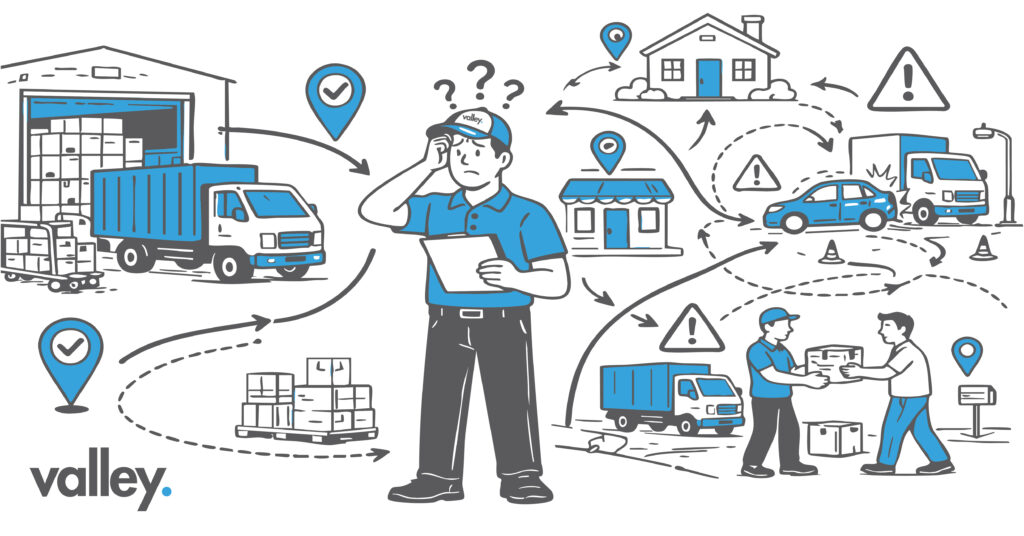
Key takeaway: Multi-stop delivery route liability in trucking refers to the compounding exposure fleet owners face when a single truck makes sequential deliveries to multiple locations in one run. Each stop creates a distinct liability event — for cargo damage, auto incidents, and third-party injury — and most standard trucking policies are not structured to account for how that exposure stacks and shifts between stops. This applies to any fleet running local distribution, LTL break-bulk routes, milk runs, or last-mile delivery loops.
Your driver leaves the terminal at 6 a.m. with a full truck and eight stops to make before noon. Stop three, a receiver notices product damage. Stop five, the driver clips a loading dock support post backing in. Stop seven, a partial unload leaves unsecured freight shifting in the trailer for the last two stops.
By the time that truck gets back to the yard, you may be looking at three separate liability questions — from three different locations, three different receivers, and three different sets of facts.
That is the problem with multi-stop delivery routes. It is not one trip. It is eight, stacked end to end with the same equipment and the same driver. And most trucking policies were written for a load that goes from point A to point B.
What Is Multi-Stop Delivery Route Liability?
Multi-stop delivery route liability is the legal and insurance exposure a trucking operation faces when a single vehicle makes sequential deliveries to multiple locations on a single trip. Each stop introduces a new opportunity for cargo loss, vehicle incidents, third-party property damage, or bodily injury claims.
The distinction from a standard point-to-point haul matters because liability does not follow a straight line on a multi-stop route. It branches. At each stop, the trucking operation is interacting with a different receiver, a different loading environment, and a different set of physical conditions. A single insurance policy written for a standard haul may respond to an incident at stop one differently than the same incident at stop five — not because the coverage changed, but because the facts and timing of the loss changed. Fleet owners running local distribution circuits, urban last-mile routes, or LTL break-bulk loops need to understand this before a claim makes it obvious.
Why Each Stop Is a New Liability Event
Cargo Responsibility Changes at Every Door
From the moment your driver leaves with a full load, your trucking operation holds legal responsibility for everything in that trailer. Under 49 U.S.C. § 14706 — commonly called the Carmack Amendment — interstate motor carriers are liable for the actual loss or injury to cargo from the time it is received until the time it is delivered.
On a multi-stop route, that window opens and partially closes at every stop. When a receiver signs for a partial delivery, that segment of cargo moves out of your legal custody. What stays in the trailer remains your responsibility — including any freight that may have shifted, been inadvertently damaged during the unload, or is now sitting against a load restraint that was designed for a full trailer.
This is not theoretical. I have seen claims where a receiver at stop four signed a clean receipt, then opened a pallet the next morning and found impact damage that almost certainly happened at stop two or three during a partial unload. By then, the bill of lading trail is muddled and the question of when the damage occurred is genuinely disputed.
Partial Unloads and the Remaining Load Problem
Every time your driver opens that trailer and pulls partial freight, the load geometry changes. Cargo that was braced and secured for a full load is now sitting in a partially empty space. Weight distribution shifts. Soft goods settle against hard goods that were previously separated.
FMCSA cargo securement regulations under 49 CFR Part 392 require that cargo be secured against movement throughout the trip — not just at the origin. That obligation does not pause between stops. If your driver makes a delivery, leaves the dock, and the remaining cargo shifts and damages a receiver’s product at the next stop, you own that claim. The securement obligation reattaches the moment the trailer doors close.
The Cargo Coverage Gap on Multi-Stop Routes
Standard motor truck cargo policies are typically structured around a shipment — from pickup to final delivery. What many fleet owners do not realize is that the policy language around partial deliveries, multiple consignees, and sequential stops can leave meaningful gaps.
The two most common gap points: first, per-occurrence limits that apply to the total load rather than each consignee’s portion, and second, policy exclusions for cargo that is left unattended in an unsecured vehicle between stops. That second one shows up constantly on urban delivery routes where the driver parks and walks freight to a suite or storefront while the rest of the load sits in an unlocked or open trailer.
FMCSA minimum cargo insurance requirements under 49 CFR Part 387 set a floor of $5,000 per vehicle and $10,000 per occurrence for property carried — numbers that have not changed since 1985 and bear no relationship to the actual value of a full trailer moving consumer goods today. Verify current minimums with FMCSA. If your policy is written to those minimums and you have a $40,000 load split across six consignees, you have a problem the moment anything goes wrong.
Auto Liability Exposure at Every Stop
Each delivery stop puts your equipment in a new physical environment. Loading docks vary. Street deliveries mean navigating traffic, tight turns, and pedestrians. Industrial parks have their own hazards. Every one of those environments is a potential auto liability event.
The liability question on a multi-stop route is compounded by frequency. A driver making eight stops has eight separate docking or parking maneuvers, eight interactions with other vehicles in tight spaces, and eight opportunities for a pedestrian or third-party property claim. A standard commercial auto liability policy covers these events — but the exposure stacks in ways that a single-stop haul simply does not replicate.
FMCSA minimum public liability requirements under 49 CFR § 387.9 set the floor for for-hire interstate trucking operations. Whether those minimums are adequate for a fleet running high-frequency urban delivery routes is a separate conversation — and one worth having with your broker before a multi-vehicle incident at a busy dock forces the issue.
Who Is Liable When Damage Happens Between Stops?
This is the question that turns a routine cargo claim into a coverage dispute. Damage discovered at stop four may have occurred at stop one, two, or three. Or it may have been pre-existing. On a multi-stop route, establishing exactly where a loss occurred is often impossible without timestamped documentation at every stop.
Under 49 CFR Part 370 — the federal regulations governing the investigation and disposition of cargo loss and damage claims — the burden of proof and timing of the claim filing matters. Receivers who notice damage at delivery and sign a clean receipt without noting exceptions on the delivery documentation significantly complicate any later claim. Your drivers need to understand this. The receiver’s signature on a clean delivery receipt is not just a formality. It is a legal document that will be part of any cargo claim dispute.
The practical answer: the trucking operation is presumed liable for cargo loss or damage from receipt to delivery under the Carmack Amendment unless a specific defense applies. On a multi-stop route, the only reliable protection is a complete documentation trail — signed receipts with noted exceptions at every stop, timestamped photos where damage is discovered, and clear records of the condition at load.
What Your Policy Probably Says (and What It Doesn’t)
Most standard trucking policies handle a single-origin, single-destination haul cleanly. Multi-stop routes introduce language questions that many fleet owners have never read past the declarations page to find.
Things to look for specifically in your cargo policy:
Unattended vehicle exclusions. If your driver leaves the cab for a delivery and the trailer is not locked, some policies exclude theft or damage that occurs during that window. On a milk run with 12 stops, the trailer is unlocked and unattended multiple times per trip.
Multiple consignee provisions. Some policies treat each consignee’s freight as a separate covered shipment. Others treat the entire truckload as a single occurrence. That distinction matters when per-occurrence limits are in play.
Schedule of values vs. blanket limits. A policy with a per-load limit may not specify how that limit applies when loss occurs to one portion of a load with multiple receivers. Review your policy language and ask your broker directly.
The federal claim processing rules under 49 CFR Part 370 also apply regardless of what your policy says — they govern how cargo loss and damage claims must be filed and investigated. Knowing both layers matters.
How to Structure Coverage for Multi-Stop Operations
Running a multi-stop delivery operation is a specific risk profile. It deserves a specific coverage review, not a standard trucking policy with the assumption that everything fits.
A few things worth addressing directly with your broker:
Cargo limits adequate for the actual load value. If you are hauling $50,000 in consumer goods split across six receivers, your cargo coverage limit needs to reflect that. The federal minimums are a compliance floor, not a coverage strategy.
Unattended vehicle exposure. Ask specifically whether your policy excludes cargo theft or damage while the driver is off the truck during a delivery. If it does, ask what it takes to close that gap — whether through endorsement, a higher security standard, or a different policy form.
Auto liability limits appropriate for urban delivery frequency. A fleet making 40 to 80 stops per day across a metro area accumulates auto liability exposure differently than a fleet running three interstate loads a week. Your limits should reflect your actual exposure frequency, not just the minimum required for your DOT authority.
Documentation protocols that support claims. This is not an insurance product — it is an operational practice. Signed receipts with noted exceptions at every stop, photos at every stop when damage is present, and driver training on what to do when a receiver disputes a delivery are all part of managing the claims exposure that comes with multi-stop work.
If your broker has never asked how many stops your average route makes or what your per-delivery documentation protocol looks like, they are writing your policy without the information they need to write it correctly.
If your current coverage has not been reviewed with multi-stop delivery exposure specifically in mind, that is worth fixing before the next claim makes it a much more expensive conversation. Get a coverage review at Valley Trucking Insurance — we ask the questions other brokers skip.
Frequently Asked Questions
Does standard trucking insurance cover multi-stop delivery routes?
A standard trucking policy will typically respond to incidents on multi-stop routes, but the coverage may have gaps specific to multi-stop operations — including unattended vehicle exclusions, per-occurrence cargo limits that don’t account for multiple consignees, and questions around when and where damage occurred between stops. Review your policy language against your actual operation.
Who is liable when cargo is damaged on a multi-stop route and the stop isn’t clear?
Under the Carmack Amendment (49 U.S.C. § 14706), the trucking operation is presumed liable for loss or damage to cargo from receipt to delivery unless a specific legal defense applies. When the stop where damage occurred is disputed, the trucking operation typically carries the burden unless documentation shows otherwise.
What is the FMCSA cargo insurance minimum for multi-stop trucking operations?
The FMCSA sets a minimum cargo insurance floor of $5,000 per vehicle and $10,000 per occurrence under 49 CFR Part 387. These are federal compliance minimums and were last updated in 1985. They are not adequate for most modern freight values — verify current requirements with FMCSA and size your coverage to the actual value of the loads you carry.
Do FMCSA cargo securement rules apply between stops on a multi-stop route?
Yes. FMCSA cargo securement requirements under 49 CFR Part 392 apply throughout the trip, not just at origin. When a partial unload changes the load geometry, the driver has an obligation to reassess and resecure the remaining freight before continuing.
What documentation does a trucking operation need to protect itself on multi-stop routes?
At minimum: a signed delivery receipt with noted exceptions at every stop, timestamped photos when damage is discovered or suspected, and clear records of cargo condition at load origin. This documentation trail is your primary defense if a receiver disputes a delivery or a cargo claim arises with an unclear point of loss.
Can a receiver’s clean signature at delivery hurt a cargo claim?
Yes. A receiver who signs a clean delivery receipt without noting damage exceptions significantly weakens any subsequent claim — both for the receiver and for establishing when and where damage occurred. Train your drivers to walk through a delivery acknowledgment process, not just hand over a clipboard.
What should fleet owners running multi-stop routes ask their insurance broker?
Ask specifically: Does my cargo policy cover partial loads between stops? Does my policy exclude cargo theft or damage when the driver is off the truck during a delivery? Are my per-occurrence limits sized to the total load value or the individual consignee value? Have they asked about your average stop count, route type, and documentation practices? If not, they are writing blind.
Is multi-stop delivery liability different for intrastate versus interstate routes?
The Carmack Amendment applies to interstate commerce. Intrastate routes may be governed by state law, which varies. The FMCSA liability minimums under 49 CFR Part 387 apply to for-hire interstate operations. Fleet owners running intrastate-only delivery routes should verify applicable state requirements with a broker familiar with their state’s commercial trucking rules.

Smarter Coverage. Real Support. No Hassle.