🔔 Announcement: American Trucking Insurance is now a part of Valley!
See details
🔔 Announcement: American Trucking Insurance is now a part of Valley!
See details

The MCS-90 Endorsement Explained: Why It’s Not Real Insurance for Your Fleet

Cameron Pechia / Jun 12, 2026
Reviewed by Cameron Pechia, Founder, WA Insurance License 71186
Last reviewed: 6/12/2026
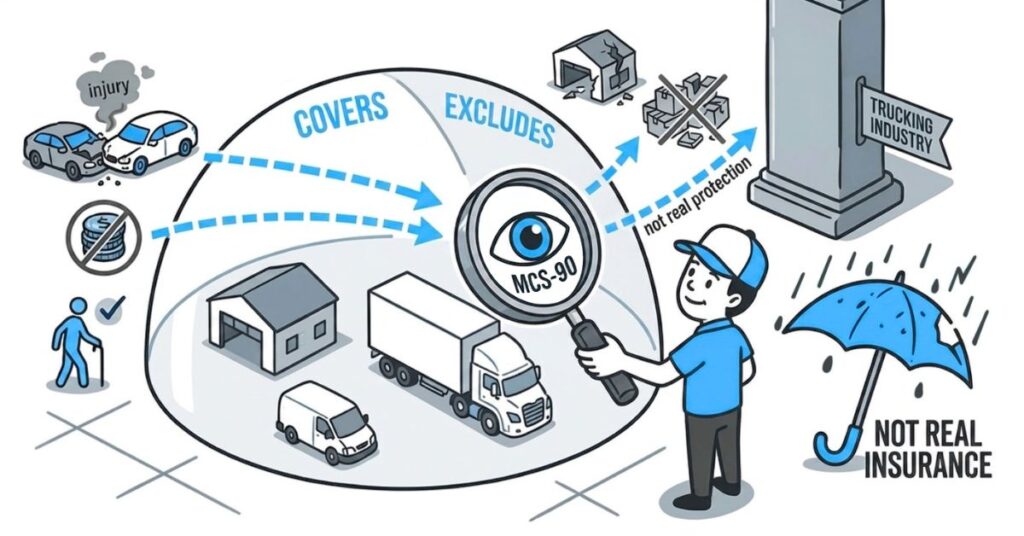
Key takeaway: The MCS-90 endorsement is a federally mandated form attached to your auto liability policy that guarantees payment to the public if your trucking company causes bodily injury or property damage and your normal insurance won’t respond. It is not coverage for your business. The insurance company pays the injured third party, then has the legal right to collect every dollar back from you. It applies to for-hire interstate motor carriers operating vehicles over 10,001 pounds GVWR, and the minimums start at $750,000 for non-hazardous freight, with higher tiers for hazmat.
There’s a moment most fleet owners go through after a serious accident that I see again and again. They pull out the policy, find the MCS-90 endorsement, and think they’re protected. They’re not. The MCS-90 is the most misunderstood document in trucking insurance, and the misunderstanding usually doesn’t surface until a settlement is being negotiated and someone hands the owner an invoice for the payout.
If you operate under your own DOT authority and run interstate, you have an MCS-90 attached to your liability policy. You have to. It’s federal law under 49 CFR § 387.15. But having it and being protected by it are two completely different things.
What the MCS-90 Endorsement Actually Is
The MCS-90 is a public protection mechanism, not a private one. It’s an endorsement attached to your auto liability policy that guarantees the federal financial responsibility minimums get paid to injured members of the public, even in situations where your normal liability coverage would deny the claim.
That last part is the whole point of the form. It was created under Sections 29 and 30 of the Motor Carrier Act of 1980 for one reason: Congress didn’t want the public left with no recovery when a trucking company’s insurance failed to respond to a legitimate claim. So they built a federal backstop. The form attaches to the policy, sits there until it’s triggered, and pays out only when standard liability won’t.
It is not a separate policy. It is not a coverage type you buy. It is a legal mechanism the federal government required insurance companies to bolt onto every for-hire interstate trucking policy that meets the financial responsibility requirements.
Who Is Legally Required to Have an MCS-90
For-hire interstate property carriers
If you operate a motor vehicle with a gross vehicle weight rating of 10,001 pounds or more in interstate or foreign commerce for hire, you fall under 49 CFR Part 387 Subpart A and need an MCS-90 endorsement on your liability policy. The federal minimum for non-hazardous freight is $750,000. Most fleets I work with carry $1 million as standard because shippers and brokers require it, but the federal floor is $750,000.
Hazmat and higher-risk commodities
If you haul oil, hazardous waste, or hazardous materials in bulk, your minimum jumps to $1 million. If you haul certain explosives, poison-gas materials, or highway route-controlled quantities of Class 7 radioactive material, the minimum jumps to $5 million. The MCS-90 attached to your policy has to reflect whichever tier applies to what you actually haul. A lot of fleets carrying mixed freight don’t realize their MCS-90 limit and their hauling activity don’t match until an auditor or a plaintiff’s attorney points it out.
What the MCS-90 Covers and What It Doesn’t
Here’s where it gets specific. The MCS-90 covers bodily injury and property damage to the public, up to the federal minimum, when your normal liability policy denies the claim for one of a narrow set of reasons. The most common triggers are:
- The vehicle wasn’t listed on the policy
- The driver wasn’t permissive or wasn’t authorized
- The load or operation fell outside the policy’s declared scope
- The coverage had lapsed or been canceled but the MCS-90 was still in effect
What the MCS-90 does not cover, ever:
- Damage to your own equipment
- Cargo loss or damage (that’s separate — cargo coverage)
- Workers’ compensation claims
- Injuries to your own drivers or employees
- Any judgment above the federal minimum
- Punitive damages in most jurisdictions
- Pollution cleanup beyond very narrow environmental restoration scenarios
This is the gap that catches fleet owners. They see “endorsement” on the policy and assume it extends their protection. It doesn’t. It extends the public’s protection. Yours stops at whatever your standard liability policy says it covers.
The Reimbursement Clause Most Fleet Owners Miss
This is the part that turns the MCS-90 from a misunderstood document into a financial threat. Read the actual endorsement language and you’ll find this: when the insurance company pays out under the MCS-90, they have the legal right to recover every dollar from you, the motor carrier.
That’s not a hypothetical. It’s written into the form. The insurer pays the injured third party because federal law requires it. Then the insurer comes after the trucking company that the policy was issued to. If your insurance denied the claim because you operated outside policy terms, that denial doesn’t go away when the MCS-90 pays. The carrier still owes the original denial reason. They paid the public to comply with federal law. They will collect from you to make themselves whole.
I’ve seen fleet owners get six-figure invoices from their insurance company after an MCS-90 trigger. Some never recovered financially. The endorsement protected the public exactly as designed. It did nothing for the business.
How the MCS-90 Differs from Real Liability Insurance
A standard auto liability policy is a contract between you and the insurance company. You pay premium. The company covers losses inside the policy terms. If a claim is denied, that’s the end of the transaction. You eat the loss or fight the denial, but the insurance company isn’t paying anyone.
The MCS-90 inverts that. It is a contract between the federal government and the insurance company, with you as the underlying party. The insurance company guarantees the government that the public gets paid. They make no promise to you. If the MCS-90 pays, you owe.
Real liability insurance is bought to protect your business. The MCS-90 is a regulatory requirement that uses your insurance company as a payment vehicle for public protection. Same policy. Two different functions. Most fleet owners only understand the first one until something goes wrong.
When the MCS-90 Gets Triggered in a Real Claim
The most common scenarios I see where the MCS-90 actually pays out are situations where the fleet drifted outside its declared operation. A few examples:
- A driver hauled a load type the policy didn’t include (general freight policy, hazmat load on the trailer)
- A vehicle was added to the fleet but never added to the policy schedule
- A driver who wasn’t on the approved roster ran a load and caused an accident
- The policy lapsed on a Friday, no one caught it, and a crash happened Monday
In each of these, the liability carrier has a legitimate basis to deny the claim against the trucking company. The MCS-90 still triggers because the public has a federally protected right to recovery up to the minimum. The carrier pays the third party. The carrier then bills the fleet owner.
If you read the case law, courts have generally held that MCS-90 reimbursement is enforceable. There are jurisdictional nuances, but the baseline assumption every fleet owner should operate under is this: if the MCS-90 pays, you pay it back.
How to Make Sure the MCS-90 Never Has to Pay Out
The goal is simple. Build a policy that responds in every scenario the MCS-90 would otherwise have to. That means:
- Schedule every vehicle. Add new equipment to the policy the day it joins the fleet, not at renewal.
- List every driver. If a driver isn’t on the policy and they run a load, you’ve created an MCS-90 scenario.
- Match your declared operation to what you actually do. If you’ve been hauling reefer loads but the policy says dry van only, fix it now.
- Match your radius to reality. A 250-mile radius policy on a fleet running coast to coast is a future denial.
- Watch the cargo class. If you’re picking up loads outside the declared cargo type, the policy has a gap.
- Keep coverage continuous. Federal law requires 35 days’ written notice for cancellation. Don’t let a missed payment or a paperwork error create a lapse.
- Review annually with someone who knows trucking. A generalist agent will not catch the gaps. A trucking specialist will.
The MCS-90 is the federal government’s way of making sure the public is protected even when your insurance fails. The way to make sure it never has to is to never let your insurance fail.
If you operate under your own authority and you’ve never had a policy review specifically focused on whether your liability matches your actual operation, that’s the gap. Bring your declarations page, your DOT activity, your driver roster, and your equipment list to someone who writes trucking every day. We’ll find the mismatch before a claim does. Send your current policy to us at Valley Trucking Insurance and we’ll walk through it with you, no charge.
Frequently Asked Questions
What is the MCS-90 endorsement in simple terms?
The MCS-90 is a federally required form attached to your auto liability policy that pays the public if your trucking company causes injury or property damage and your normal insurance won’t cover it. The insurance company then has the right to collect that payment back from you.
Is the MCS-90 the same as my liability insurance?
No. The MCS-90 is an endorsement that sits on top of your liability policy. It only pays when your standard liability would otherwise deny the claim. Your liability policy is what actually protects your business.
Does the MCS-90 cover cargo damage?
No. Cargo coverage is a separate policy line. The MCS-90 only covers bodily injury and property damage to the public, not damage to freight you were hauling.
Who is required to have an MCS-90 endorsement?
For-hire motor carriers operating vehicles over 10,001 pounds GVWR in interstate or foreign commerce. Hazmat haulers and certain higher-risk commodity haulers also need MCS-90B forms or higher MCS-90 limits depending on what they transport.
What is the minimum MCS-90 limit?
$750,000 for non-hazardous property. $1 million for oil, hazardous waste, and certain hazardous materials. $5 million for the highest-risk commodities like bulk explosives and certain radioactive materials.
Will my insurance company really collect from me after an MCS-90 payout?
Yes. The MCS-90 reimbursement clause is written into the form itself, and courts have generally upheld it. If the endorsement pays because your normal coverage denied the claim, the insurance company has the legal right to recover the payment from your trucking company.
Can I have an MCS-90 without underlying liability insurance?
The MCS-90 is an endorsement, meaning it has to be attached to an underlying liability policy. You can’t have just the MCS-90. Without a policy for it to attach to, there is nothing for the form to endorse.
How do I avoid ever needing the MCS-90 to be triggered?
Keep your liability policy current and accurate. Every vehicle scheduled, every driver listed, every cargo type and route declared correctly. The MCS-90 only fires when your normal insurance refuses to. Eliminate the refusal triggers and the endorsement stays dormant.

Smarter Coverage. Real Support. No Hassle.