🔔 Announcement: American Trucking Insurance is now a part of Valley!
See details
🔔 Announcement: American Trucking Insurance is now a part of Valley!
See details

Lumper Fees and Warehouse Damage: Who Carries the Liability?

Cameron Pechia / Apr 10, 2026
Reviewed by Cameron Pechia, Founder, WA Insurance License 71186
Last reviewed: 4/10/2026
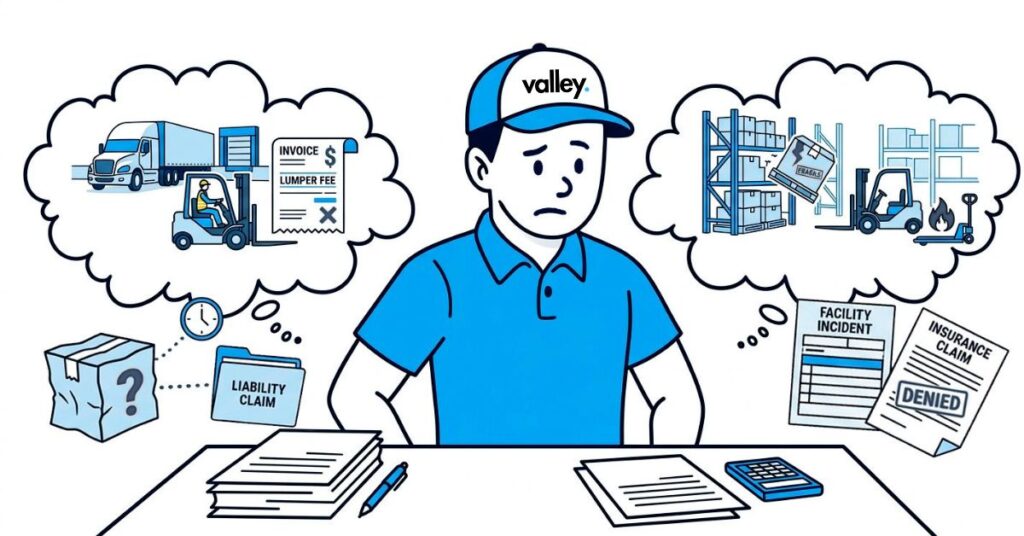
Key takeaway: Lumper fees are charges paid for third-party labor to load or unload freight at warehouses and distribution centers. When a lumper damages cargo during unloading, the liability question gets complicated fast — and most motor truck cargo policies have specific rules about when care/custody/control transfers, whether loading and unloading is covered, and who holds the bag if a third-party worker causes the loss. This applies to any for-hire or contract fleet running loads into warehouse facilities, distribution centers, or grocery DCs where lumper services are standard.
Your load makes it 1,400 miles without a scratch. The driver backs into the dock. The lumpers take over. And somewhere between the trailer and the warehouse floor, three pallets of product end up damaged.
Now comes the real question: whose problem is that?
The answer is not as clean as most fleet owners assume. It depends on who hired the lumper, what your cargo policy says about loading and unloading, and whether the freight was still in your care/custody/control at the moment the damage happened. Get any of those wrong and you are looking at a denied claim, a shipper dispute, or an out-of-pocket loss on freight you never touched.
What Are Lumper Fees and Why Do They Create Liability Questions?
Lumpers are third-party workers hired to load or unload freight at warehouses, distribution centers, and delivery points. They are not employees of the trucking operation. They are not employees of the warehouse, in most cases. They are specialized labor brought in to handle the physical work of moving freight off a trailer — and fleet owners deal with them constantly, especially on grocery, food distribution, and retail warehouse loads.
Federal law under 49 U.S.C. § 14103 requires that if a driver is asked to use a lumper service, the cost must be reimbursed. The rate confirmation should spell out whether lumper fees are covered, and if it does not, that is a conversation to have with the broker before the truck rolls. Fees typically run anywhere from $25 for a simple palletized drop to $300 or more for floor-loaded grocery shipments — the complexity of the work drives the cost.
The liability issue is separate from the payment question. When a lumper damages freight, the question is not who paid them. The question is who was responsible for the cargo at the moment it happened. That answer lives in your motor truck cargo policy and in the bill of lading — not in whoever wrote the check to the lumper service.
Who Actually Controls the Freight at the Dock?
The Care/Custody/Control Trigger
Motor truck cargo policies cover the legal liability of a trucking operation for freight while it is in their care, custody, and control. That phrase is doing a lot of work. From the moment the bill of lading is signed at pickup to the moment the load is delivered and signed for at the destination, the general rule is that the freight is your responsibility.
But the dock is a gray zone. The driver has backed in. The lumpers are unloading. Nobody has signed the delivery receipt yet. Is the freight still in your care/custody/control? In most cases, yes — until the consignee accepts it, the freight legally remains your problem. The care, custody, or control (CCC) concept is not something your general liability policy will cover, which is exactly why a separate motor truck cargo policy exists. Your GL policy typically excludes property damage to goods in your care, custody, or control. That exposure lives on the cargo side.
When the Lumper Is a Third Party, Not Your Employee
Here is where it gets specific: if you hired the lumper directly — meaning you or your driver arranged and paid for the service — most cargo insurers treat the lumper’s actions as occurring within your operational control. The damage happened while the freight was still under your watch. That likely means it falls to your cargo policy.
If the warehouse hired the lumper and the lumper service is operating under the warehouse’s contract, the picture shifts. The warehouse may carry its own liability coverage for dock operations. But do not count on that coverage responding quickly or cleanly. Warehouse operators’ liability policies routinely contain their own care/custody/control exclusions for freight in transit. Courts have found that if the warehouse was supervising the unloading operation, they may have had possessory control — and their insurer may deny the claim on that basis. You may end up in a dispute between two insurers while the shipper files a claim against you.
What Your Motor Truck Cargo Policy Covers (and Where It Stops)
Loading and Unloading Coverage Is Not Automatic
A standard motor truck cargo policy covers the legal liability of the trucking operation for freight in its care, custody, and control during transportation. What it does not always do is explicitly extend to third-party loading and unloading operations.
Some policies cover loading and unloading as part of the transportation scope. Others have sub-limits or exclusions that apply specifically to dock operations. A few are silent on the question entirely, which means the claim goes to the adjuster’s interpretation of the policy language. Read your policy. Not the summary. The actual language. If you cannot find clear language confirming that cargo damage caused during unloading by a third-party lumper is covered, ask your broker to get the answer in writing before you take another load to a lumper facility.
The Warehouse Damage Gap
A separate and common exposure is damage to the warehouse facility or its equipment caused during delivery operations. A forklift collision at the dock. A damaged bay door. Product that falls and ruins racking. These claims typically run through your commercial general liability policy — not cargo. But if the lumper caused the damage while unloading your freight, the facility may come to you first. Your GL may respond, but only if the damage does not fall under a CCC exclusion. If your driver was still present and supervising, that muddies the water further.
This is not a theoretical scenario. Warehouse damage claims tied to delivery operations come up regularly, and they almost always involve a dispute about who was in control of what at what moment. Keep your driver on the dock, keep the paperwork current, and know which policy is supposed to respond before a claim is filed.
Who Pays When a Lumper Damages Freight?
The short answer: it depends on who arranged the lumper and what your cargo policy says about third-party handling. The practical answer: expect a fight before you get a resolution.
When freight is damaged during unloading, the shipper will typically file a claim against the trucking company under the Carmack Amendment framework — because you signed the bill of lading at pickup and accepted liability for the load. Your cargo policy is the first line of response. From there, your insurer may subrogate against the lumper service or the warehouse operator if there is a clear case that their actions caused the loss.
The lumper company does carry its own liability insurance in most cases. But collecting against a lumper service’s policy is not fast, and shippers are not going to wait while that plays out. They are coming to you. Your policy needs to be structured to respond first, with subrogation rights preserved so your insurer can recover later.
The rate confirmation matters here. If it specifies that lumper fees are the shipper’s or broker’s responsibility, that can affect who had effective control over the unloading operation — and therefore who carries the liability. Preserve that document.
How the Carmack Amendment Applies to Dock-Side Claims
The Carmack Amendment, codified at 49 U.S.C. § 14706, establishes the liability framework for motor carriers transporting property in interstate commerce. Under Carmack, a trucking operation that accepts freight by signing a bill of lading is liable for any loss or damage to that freight — unless the loss resulted from one of the recognized exceptions: an act of God, act of a public enemy, act of the shipper, inherent vice of the goods, or act of public authority.
A lumper dropping a pallet does not qualify as any of those exceptions. If the freight was in your care under the bill of lading and it was damaged at the dock, Carmack puts you on the hook for the shipper’s loss. The claims process under 49 CFR Part 370 requires that a proper claim be filed in writing with supporting documentation — the bill of lading, invoice, and evidence of the destination value of the damaged goods. Claims must generally be filed within 9 months of delivery under standard bill of lading terms, with a 2-year window to bring suit after a claim denial.
The takeaway: Carmack does not care that a third-party lumper caused the damage. Your name is on the bill of lading. Your operation is in the crosshairs first.
What to Document at Every Delivery to Protect Your Claim
Getting a cargo or warehouse damage claim paid — or successfully pushing it to the right party — depends entirely on what was documented at the dock. Here is the minimum:
- Lumper receipt: Always get one. It records who did the unloading, the fee paid, the date, and the time. This is your paper trail if the claim goes sideways.
- Bill of lading notation: If there is visible damage or a short count at delivery, note it on the delivery receipt before anyone signs. A clean delivery receipt with damage discovered afterward is a much harder claim.
- Photos: Before the lumpers touch the load, photograph the cargo condition at the door. If damage happens during unloading, photograph it immediately.
- Rate confirmation: Keep the rate con in the load file. It establishes who was responsible for lumper payment and sets the operational context.
- Driver presence: Your driver should stay at the dock during unloading. An unattended trailer with a lumper crew and no documentation if something goes wrong is a coverage problem waiting to happen.
Your insurer will ask for all of this. Have it ready.
What to Ask Your Broker Before the Next Load
If you are regularly running loads to warehouse facilities that use lumper services, ask your broker these questions before the next renewal:
Does my cargo policy explicitly cover cargo damage caused during unloading by a third-party lumper? What does my policy say about care/custody/control transfer at the time of delivery? Is there a sub-limit or exclusion for loading and unloading operations? Does my GL policy contain a CCC exclusion, and how does it interact with my cargo coverage at the dock? If a lumper damages the warehouse facility during my delivery, which policy responds?
If your broker has to look up the answers, that is useful information. If they cannot give you clear answers, you need a different broker.
If you want those answers now, reach out to the team at Valley Trucking Insurance. We review cargo policy language, loading and unloading exposures, and the full range of dock-side liability questions that come with running freight into high-volume warehouse facilities. Start with a coverage review at Valley Trucking Insurance.
Frequently Asked Questions
What is a lumper fee in trucking?
A lumper fee is a charge paid for third-party labor to load or unload freight at a warehouse, distribution center, or delivery point. The driver typically pays upfront and is reimbursed by the broker or shipper. Fees vary based on freight type and volume, generally ranging from $25 to $300 or more for complex loads.
Who is responsible for cargo damaged by a lumper?
Under the Carmack Amendment, the trucking operation that signed the bill of lading carries primary liability for the freight until delivery is accepted. If a lumper damages cargo during unloading, the shipper will typically file against the trucking company first. Your cargo policy should respond, with subrogation rights allowing your insurer to recover from the lumper service or warehouse if their negligence caused the loss.
Does motor truck cargo insurance cover loading and unloading?
It depends on the policy. Some motor truck cargo policies explicitly cover cargo damage during loading and unloading operations. Others have sub-limits, exclusions, or ambiguous language that requires adjuster interpretation. Review your policy language directly and get confirmation from your broker in writing.
What does care/custody/control mean in a trucking cargo claim?
Care, custody, and control (CCC) describes the period during which a trucking operation is legally responsible for freight — generally from the signing of the bill of lading at pickup through acceptance of delivery at the destination. Damage that occurs during this window falls under the cargo policy. CCC is also an exclusion in general liability policies, meaning GL coverage will not respond to freight damage — that exposure requires a separate cargo policy.
Does the Carmack Amendment apply to warehouse damage at delivery?
The Carmack Amendment governs motor carrier liability for loss or damage to freight in interstate commerce. It applies from pickup through delivery. If freight is damaged during unloading at a warehouse and has not yet been accepted by the consignee, the trucking operation may still be liable under Carmack. The recognized exceptions — act of God, inherent vice, shipper’s fault — do not cover lumper negligence.
What should a driver do if a lumper damages freight?
Document everything immediately. Note the damage on the delivery receipt before signing. Photograph the damaged freight. Keep the lumper receipt. Notify the trucking company and broker right away. Do not sign a clean delivery receipt if there is visible damage — that notation is critical to a successful cargo claim.
Can a trucking company recover costs from a lumper service after a cargo claim?
Yes, through subrogation. If your cargo insurer pays the shipper’s claim, they can pursue the lumper service or warehouse operator for recovery if those parties were responsible for the damage. The rate confirmation and lumper receipt are key documents in a subrogation case. Preserve them.
Does my general liability policy cover warehouse damage caused during delivery?
It may, but most commercial GL policies contain a care, custody, or control exclusion that eliminates coverage for property in the trucking operation’s control at the time of damage. If the freight or the dock equipment was under your operational control during unloading, GL may not respond. Verify with your broker which policy is structured to respond to dock-side facility damage before a claim is filed.

Smarter Coverage. Real Support. No Hassle.