🔔 Announcement: American Trucking Insurance is now a part of Valley!
See details
🔔 Announcement: American Trucking Insurance is now a part of Valley!
See details

When the Load Shifts, the First Question Is About Your Paperwork

Cameron Pechia / Jun 10, 2026
Reviewed by Cameron Pechia, Founder, WA Insurance License 71186
Last reviewed: 5/19/2026
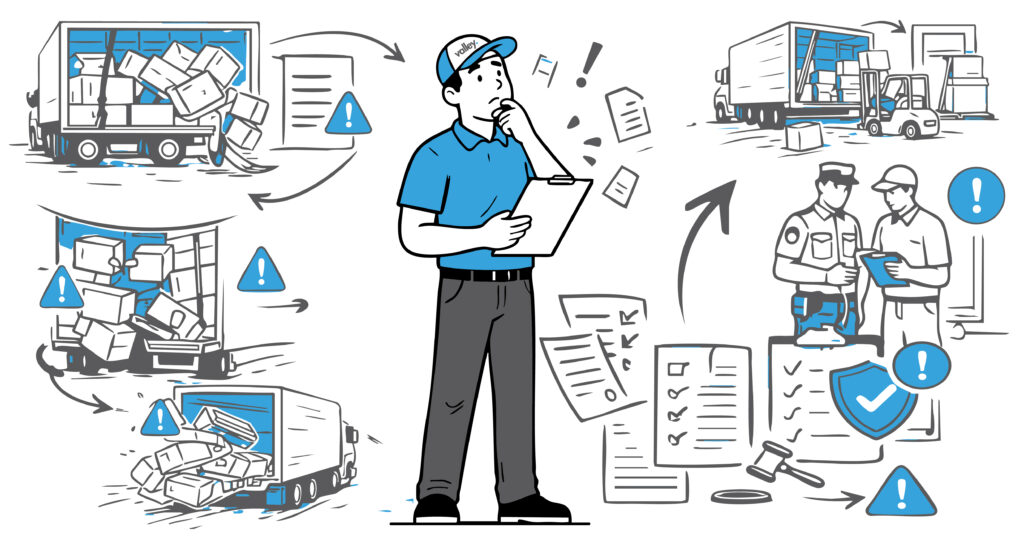
Key takeaway: Load securement documentation insurance claims hinge on one question: can you prove, in writing, that your cargo was secured to federal standard before the truck left the yard? Under 49 CFR 393, every commercial motor vehicle transporting cargo in interstate commerce must meet specific tiedown, working load limit, and inspection requirements. When a load shifts, falls, or causes an accident and documentation is missing or incomplete, insurers and opposing counsel treat that gap as evidence of negligence. That exposure sits in your cargo policy, your general liability, and your auto liability coverage simultaneously. Fleet owners who treat securement logs as optional are leaving all three open.
You had a load shift last spring. Your driver did everything right — checked the straps at the first stop, noted no visible movement, delivered intact. But a car clipped the rear of the trailer on the interstate, claimed the load was protruding, and filed a liability claim. The first thing your adjuster asked for was the securement log.
There wasn’t one. Not a complete one. A handwritten note on a BOL, a couple of photos on a phone that couldn’t be dated reliably. The adjuster didn’t deny the claim outright — but the defense position weakened the moment documentation fell apart. That’s the story I hear more than any other when fleet operators call after an incident.
The paperwork isn’t bureaucratic filler. It’s the proof your operation ran the load correctly.
What Load Securement Documentation Actually Is (and Why Adjusters Care)
Load securement documentation is the written and photographic record proving that cargo was secured in compliance with 49 CFR Part 393 before a vehicle left the loading point and was re-inspected within the first 50 miles of transit and after any change in load condition. It’s not a single form. It’s a combination of the driver’s pre-trip inspection records, load-specific securement notes, tiedown device condition logs, and any photos taken at load time.
Adjusters care because their job is to determine fault and assign liability. When a load-related incident occurs — cargo falling, a shifted load causing a rollover, a strapped item damaging a third party’s property — the adjuster has to answer: was the cargo properly secured? Without documentation, there’s no answer. And “no answer” in a liability dispute defaults to the worst available assumption.
The FMCSA’s cargo securement rules apply to all cargo-carrying commercial motor vehicles in interstate commerce. That’s the baseline. But the documentation requirement doesn’t just serve compliance — it serves your defense. Every note your driver made before departure is a timestamped record that the load was in acceptable condition at origin. Take that away and you’re arguing with nothing.
The Federal Rules Your Documentation Has to Reflect
49 CFR 393.100 — The General Requirement
The cargo securement rules in 49 CFR 393.100 establish that every commercial motor vehicle must be loaded and equipped so cargo cannot leak, spill, blow, or fall from the vehicle. That’s the floor. Subpart I of Part 393 then builds the specific requirements: tiedown counts based on cargo weight and length, working load limit calculations, performance standards for all securement devices, and commodity-specific rules for loads like metal coils, heavy equipment, and flatbed freight.
Cornell Law’s LII version of 49 CFR Subpart I is worth bookmarking as a plain-English reference for your safety team. The rule is readable and specific. It tells you exactly how many tiedowns a 20-foot load requires, what working load limit those tiedowns have to meet in aggregate, and which commodity types trigger additional requirements beyond the general rules.
Tiedown Count, Working Load Limits, and the Paper Trail
Under 49 CFR 393.106, the aggregate working load limit of all tiedowns must equal at least half the weight of the cargo being secured. That’s a specific, calculable number — not an approximation. If your driver used four straps rated at 3,000 lbs working load limit each, the aggregate is 12,000 lbs. If the load weighed 26,000 lbs, you were short. An adjuster with access to the load’s bill of lading and your driver’s equipment log can run that math in five minutes.
This is where the paper trail matters operationally. Drivers need to record which devices they used, their working load limit ratings, and how many were applied per article or group. Fleets that use standardized securement logs — with fields for load weight, device type, device rating, and tiedown count — can reconstruct compliance from the record alone. Fleets that don’t can’t.
How a Documentation Gap Becomes a Claim Denial
The “Pre-Existing Condition” Argument
One of the most common tactics in load-related liability disputes is the argument that the cargo was improperly secured at origin, not that something failed en route. If a third party was injured by falling cargo, their attorney will argue the load was never compliant. Your defense is the securement log from departure. Without it, you have no rebuttal to that framing.
This is not a hypothetical. It’s the standard playbook in cargo-related injury litigation. The absence of documentation creates the inference of non-compliance. Insurers know this. When an adjuster sees no securement log, no device condition notes, and no pre-trip inspection record tied to that specific load, they start calculating shared liability exposure — and then they start asking harder questions about your training records and your fleet’s securement protocols. The documentation hole becomes a broader credibility problem.
Comparative Negligence and Shared Liability Exposure
Most states use comparative negligence rules, which means fault gets apportioned between parties. If your fleet is found 30% at fault for a cargo-related incident because you couldn’t document compliance, that 30% comes out of your liability coverage. On a serious injury claim, that’s not a small number. And if your auto liability policy has exclusions for regulatory non-compliance, the carrier may argue the violation — undocumented tiedowns — is grounds for a coverage dispute, not just a settlement reduction.
The interaction between federal securement regulations and insurance policy language is something most fleet owners don’t think about until they’re in the middle of a claim. Policies are written with the assumption that you’re operating legally. A documented violation of 49 CFR 393 doesn’t automatically void coverage, but it complicates every conversation with your adjuster and every position your defense counsel takes.
What Your Drivers Should Be Recording on Every Load
A complete securement record for a single load should contain at minimum:
- Load description, weight, and dimensions
- Number of tiedowns applied and device type (chain, synthetic webbing, wire rope)
- Working load limit of each device used
- Notation that devices were free from visible damage before use (per 49 CFR 393.104)
- Time and location of first re-inspection (required within 50 miles of departure)
- Any adjustments made during transit and why
- Driver signature and date
Photos help, but only if they’re timestamped and stored somewhere retrievable. A photo on a personal phone that gets lost or deleted before a claim is investigated is worth nothing. Fleets that use a driver app or fleet management platform with photo attachment and GPS timestamps are in a much stronger documentation position than fleets relying on drivers to text images to a dispatcher and hope they get saved.
The re-inspection requirement catches a lot of fleets off guard. FMCSA’s rules require re-inspection within the first 50 miles of a trip and after any change in load condition. If your driver re-inspected and didn’t write it down, it didn’t happen — at least not in a way that survives a claims investigation.
What Fleet Owners Get Wrong at the Policy Level
Most fleet owners assume that if they have a cargo policy and an auto liability policy, a load-related incident is covered. That assumption holds until it doesn’t. The gap shows up in three places.
First, cargo policies cover the freight you’re transporting — not third-party bodily injury or property damage caused by the load leaving the truck. That exposure sits in your auto liability coverage. Second, auto liability policies cover incidents involving the operation of the vehicle, but defense counsel can argue that improperly secured cargo is a separate act of negligence not covered by the standard auto policy form without endorsement. Third, general liability policies typically exclude transportation-related incidents entirely.
The scenario where all three policies are in play — cargo damaged, third party injured, vehicle involved in a collision triggered by the load shift — is not rare. It happens on flatbed operations, open-deck specialty freight, and any load with significant weight and irregular geometry. Fleets running that kind of freight without reviewing how their policies interact are carrying exposure they don’t know about.
How Your Insurance Policy Interacts With Securement Violations
An insurance adjuster reviewing a load-related claim will pull your FMCSA Safety Measurement System (SMS) data, your driver’s CSA scores, your maintenance records, and any prior violations tied to cargo securement. If your fleet has open cargo securement violations in the FMCSA system — and you haven’t corrected them or documented correction — that history becomes part of the liability picture.
A single prior securement violation on a driver’s record doesn’t void a claim. But a pattern does create problems. Adjusters and defense attorneys look for pattern evidence to establish that the fleet knew about a securement risk and didn’t address it. That’s where punitive exposure starts. And that’s where a fleet’s coverage limits, which looked adequate at renewal, suddenly don’t look adequate at all.
What actually protects you isn’t just having the right policy limits. It’s being able to demonstrate that your operation takes securement compliance seriously — through training records, documented protocols, completed inspection logs, and a history of corrective action when violations occur. That combination is what adjusters and defense counsel see as a managed operation. Without it, every incident starts from a weaker position.
If your operation runs flatbed, open deck, or heavy haul freight and you haven’t reviewed your cargo coverage, auto liability limits, and securement documentation protocols together, that’s the conversation worth having before the next load goes out. Get a coverage review here at Valley Trucking Insurance and we’ll walk through where your documentation practices and your policy interact — and where the gaps are.
Frequently Asked Questions About Load Securement Documentation and Insurance Claims
Does missing load securement documentation automatically void a cargo insurance claim?
Not automatically, but it creates serious problems. Adjusters use documentation gaps to build an argument for shared fault or pre-existing non-compliance. A missing securement log weakens your defense position and can reduce the value of what your policy pays out.
What federal regulation governs load securement requirements for commercial trucks?
49 CFR Part 393, Subpart I governs cargo securement for commercial motor vehicles in interstate commerce. It covers general requirements, tiedown standards, working load limits, and commodity-specific rules. The full text is available at eCFR.gov.
How often are drivers required to inspect load securement during a trip?
FMCSA rules require re-inspection within the first 50 miles of a trip and after any change in load condition, any change in duty status, or after the vehicle has been driven for 3 hours or 150 miles — whichever comes first. All re-inspections should be recorded.
Can a cargo securement violation affect my auto liability coverage?
Yes. If a cargo securement violation contributed to an incident, opposing counsel can argue the fleet was operating out of compliance with federal regulations. That argument affects how liability is apportioned under comparative negligence rules and can complicate what your auto liability policy will cover.
What should a driver’s load securement log include?
At minimum: load weight and description, number and type of tiedown devices used, working load limit of each device, a notation that devices were inspected and undamaged, time and location of first re-inspection, any in-transit adjustments, and driver signature.
Does general liability insurance cover cargo-related third-party injuries?
Generally, no. Standard general liability policies exclude transportation-related incidents. Third-party bodily injury and property damage from a load falling off a truck typically falls under auto liability coverage, not general liability.
What is the working load limit rule for tiedowns under 49 CFR 393?
Under 49 CFR 393.106, the aggregate working load limit of all tiedowns must be at least half the weight of the cargo being secured. Each device used must also be in proper working order with no visible damage.
If my driver re-inspected the load but didn’t document it, does that re-inspection count?
For insurance and legal purposes, an undocumented re-inspection is very difficult to prove. If a claim goes to litigation and there’s no written record, the re-inspection effectively didn’t happen from a defense standpoint. Written records with timestamps are the only reliable evidence.

Smarter Coverage. Real Support. No Hassle.