🔔 Announcement: American Trucking Insurance is now a part of Valley!
See details
🔔 Announcement: American Trucking Insurance is now a part of Valley!
See details

Last-Mile Trucking Insurance Coverage Gaps Fleet Owners Need to Know

Cameron Pechia / Jun 10, 2026
Reviewed by Cameron Pechia, Founder, WA Insurance License 71186
Last reviewed: 4/22/2026
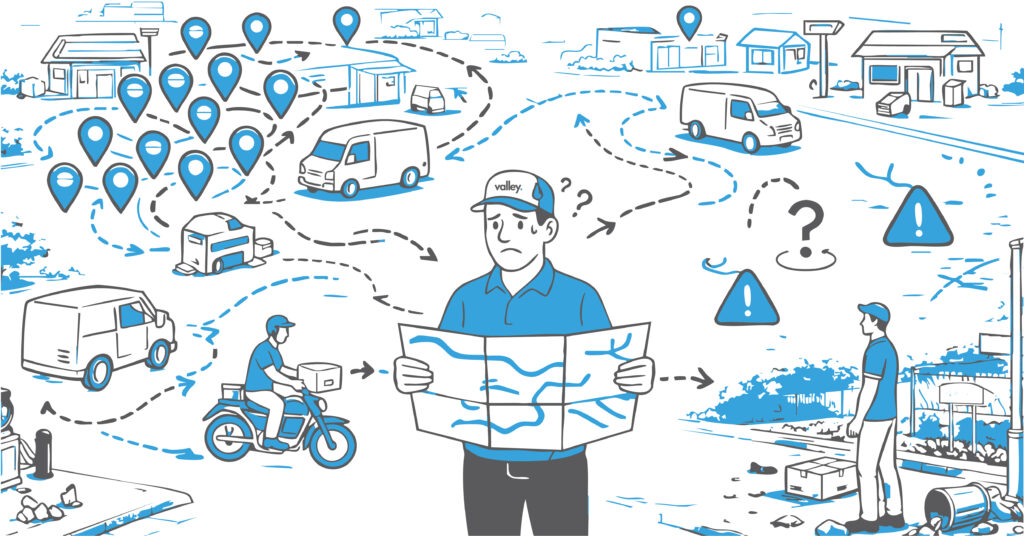
Key Takeaway: Last-mile trucking insurance coverage gaps are the specific points in a standard commercial trucking policy where final-delivery operations fall outside covered territory — often without the fleet owner knowing it. These gaps show up in cargo valuation language, vehicle scheduling requirements, contractor driver liability, and general liability exposures that long-haul-focused policies were never written to address. They apply to any fleet running high-frequency, short-distance delivery routes: DSPs, regional distributors, grocery delivery operations, medical supply fleets, and owner-operators who have shifted toward final-mile work. You will not find these gaps on your policy’s declarations page. You find them in the exclusions — and usually only after a claim gets denied.
You take 80 stops a day. Dense urban routes, residential neighborhoods, commercial strip malls. Your trucks are box vans and sprinters, not 18-wheelers. You’ve got a commercial auto policy and cargo coverage on file. Compliant, right?
Maybe on paper. But last-mile trucking puts vehicles and drivers into scenarios that most standard trucking policies weren’t designed for. The risk profile is fundamentally different from over-the-road freight. Shorter distances, more stops, more frequent loading and unloading, more interaction with customers and their property, more use of subcontractors and personal vehicles. Every one of those differences is a place where a standard policy might not follow you.
Here’s where the gaps actually are.
What Are Last-Mile Trucking Insurance Coverage Gaps?
Last-mile trucking insurance coverage gaps are the points where a fleet’s existing policies stop covering the specific risks of final-delivery operations. They are not always the result of buying bad insurance. They are often the result of buying insurance designed for a different kind of trucking operation and assuming it translates to last-mile work.
Standard commercial trucking policies were built around over-the-road freight: a single driver, a specific truck, freight that stays in the trailer from origin to destination. Last-mile work breaks every one of those assumptions. Vehicles are smaller, stop counts are higher, cargo changes hands more often, and drivers frequently operate in residential settings where property damage claims look completely different than a highway accident. When an underwriter prices a standard trucking policy, they are pricing a different operational model than what last-mile fleets actually run. That mismatch is where coverage gaps form — and where claim denials come from.
The Vehicle Weight Trap: How GVW Changes Your Liability Floor
This is the gap most last-mile operators don’t know exists until it’s too late. FMCSA financial responsibility requirements under 49 CFR Part 387 set the minimum public liability floor at $750,000 for for-hire property carriers operating vehicles with a gross vehicle weight rating (GVWR) over 10,001 lbs in interstate commerce. Drop below that weight threshold and the federal floor drops with you — to $300,000 for many intrastate last-mile operations.
Box trucks and sprinter vans used for last-mile work often fall right around that 10,001-lb threshold. Depending on the exact GVWR of the vehicle and how it’s rated on your policy, you might be sitting at a $300,000 liability limit without realizing the exposure that creates. In today’s environment — where nuclear verdicts against trucking operations exceed $10 million with increasing regularity — a $300,000 limit on a vehicle that hits a pedestrian in a residential neighborhood isn’t a policy. It’s a placeholder.
Most shippers and retail customers now require $1 million in liability coverage as a contract condition regardless of vehicle weight. If your policy was set up around the federal minimum for lighter vehicles, you may already be in breach of your delivery contracts — and you probably don’t know it. Verify current minimum requirements with your state insurance commissioner or the FMCSA for your specific operation.
Cargo Coverage Stops at the Tailgate — Usually
Motor truck cargo insurance covers freight in your care, custody, and control. That sounds broad. It isn’t.
Most cargo policies were written for freight that lives in a locked trailer and doesn’t come out until a dock. Last-mile freight comes out at every stop. It moves from the truck to the driver’s hands, across a customer’s property, and sometimes into their home or business. That physical movement is where a lot of cargo policies quietly stop covering you.
The “Scheduled Vehicle” Problem
Most cargo policies only extend coverage to vehicles specifically listed — “scheduled” — on the policy. That works fine if you run a fixed fleet of owned trucks. It falls apart when you use independent contractors driving their own vans, or when you add rental vehicles during peak season. If a contractor’s vehicle isn’t on your schedule and they damage or lose cargo during a delivery, your cargo policy may deny the claim entirely.
The fix requires explicit policy language that extends cargo coverage to non-owned vehicles in your operation. Some policies offer this. Most standard ones don’t include it automatically. Ask your broker directly whether your current policy covers cargo in vehicles you don’t own. If they have to look it up, that’s already a warning sign.
How Claim Valuation Language Can Cut Your Payout
Here’s a gap that’s almost invisible until you need it. Many cargo policies calculate claim payouts as the lowest of three values: repair cost, replacement cost, or the amount printed on the delivery receipt or bill of lading. For high-volume last-mile operations — especially those handling consumer goods with low declared values on shipping labels — this can mean a $1,200 laptop pays out at $100 because that’s what the receipt says.
If you’re handling consumer electronics, medical devices, or any cargo where the declared value on the paperwork doesn’t reflect replacement cost, your cargo policy may be severely underpaying on claims. You need replacement-cost valuation language in your policy, not the default lowest-value calculation.
Contractor Drivers and the Hired/Non-Owned Auto Gap
A lot of last-mile fleets run a mix of employees and 1099 contractors. The insurance assumption is that contractors carry their own coverage. The reality is that personal auto policies don’t cover commercial delivery activity. Full stop.
A contractor’s personal auto policy almost always includes a business-use exclusion. The moment they’re delivering freight under your dispatch, they’re in commercial use territory and their personal policy won’t pay. That means any accident they cause while working for you becomes your problem — unless you have hired and non-owned auto liability (HNOA) coverage in place.
HNOA coverage extends your commercial auto liability to vehicles you don’t own but that operate on your behalf. It’s a specific endorsement — not a standard feature of most trucking policies. Without it, every contractor vehicle running your loads is a rolling uninsured exposure. And if that contractor hits someone and their personal policy denies the claim, the plaintiff’s attorney isn’t going after the driver. They’re going after the operation that dispatched them.
General Liability: The Coverage Nobody Thinks About Until a Delivery Goes Wrong
Commercial auto covers accidents involving the vehicle. It does not cover everything that happens during a delivery.
Your driver backs in fine, parks the truck, and then slips on ice while carrying a package to someone’s front door. A customer’s kid trips over a box the driver set on the front steps. A driver inadvertently damages a customer’s property — a wall, a piece of furniture, a landscaping feature — while maneuvering through a tight space. None of those are auto incidents. All of them can generate liability claims.
General liability (GL) coverage is what responds in those scenarios. It covers bodily injury and property damage claims that aren’t vehicle-related. Many trucking policies are structured as commercial auto only, with GL either absent or purchased as a separate policy that wasn’t set up with delivery operations in mind. If your GL policy excludes operations “in the course of transportation,” you may have a gap right in the middle of the most common scenario your drivers face every day.
A completed operations endorsement — which extends GL coverage to incidents that happen after a delivery is technically finished — is worth asking about specifically. If your driver completes a delivery and a package causes injury or property damage after they’ve left, completed operations coverage is what responds.
Workers’ Comp Exposure in Last-Mile Fleets
Last-mile work generates workers’ comp claims at a different rate than over-the-road freight. Higher stop counts mean more loading and unloading repetitions. More time in and out of vehicles means more slip-and-fall exposure. Tight urban delivery schedules put drivers under pressure that leads to rushed movements and injuries.
If you’re running employee drivers, workers’ comp is required in virtually every state. The gap usually shows up with contractors. If a 1099 driver is injured while working for you and they don’t carry their own occupational accident coverage, a workers’ comp-style claim can come back to the operation in states where labor classification comes into question. Occupational accident (occ/acc) policies for independent contractors are a partial solution, but they don’t replace workers’ comp and the coverage limits differ significantly. Verify your contractor classification and your state’s specific workers’ comp requirements before assuming you’re covered.
What a Last-Mile Insurance Package Should Actually Cover
A policy stack built for last-mile operations looks different from a standard long-haul trucking policy. At minimum it should include:
- Commercial auto liability at limits that meet both federal minimums and your actual contract requirements — typically $1 million or higher regardless of vehicle weight
- Motor truck cargo with non-owned vehicle coverage and replacement-cost valuation language, not the default lowest-value calculation
- Hired and non-owned auto (HNOA) covering contractor vehicles operating under your dispatch
- General liability with no transportation-activity exclusions, plus a completed operations endorsement
- Physical damage on your owned fleet (not federally required, but a serious exposure if you’re leasing or financing vehicles)
- Occupational accident coverage for contractor drivers, if they aren’t carrying their own
The weight of each vehicle, the nature of the cargo, how you use contractors, and which states you operate in all affect which coverages need which specific limits and endorsements. A single policy description doesn’t capture what a specific operation actually needs.
How to Audit Your Current Policy for These Gaps
Pull your policy documents — not the summary sheet your broker sends at renewal. The actual policy form and all endorsements. Look for these specifically:
First, check the scheduled vehicle list. Is every vehicle in your operation — including contractor vehicles — either listed or covered by a non-owned auto endorsement? Second, look at the cargo policy’s valuation clause. Does it pay replacement cost or the lowest of three values? Third, find your GL policy and read the exclusions. Is there any language excluding operations involving transportation or delivery? Fourth, check whether you have an HNOA endorsement. If your broker isn’t sure what that is, that’s your answer. Fifth, look at your liability limits relative to your actual contract requirements with shippers and retail customers. If they require $1 million and you’re carrying $750,000, you’re already in breach.
Most of these gaps don’t show up on the declarations page. They live in the fine print — and in what’s missing entirely.
If your fleet runs last-mile routes — any combination of box trucks, sprinters, or contractor vehicles making residential or commercial deliveries — your policy deserves a hard look before the next renewal. The coverage gaps in last-mile trucking operations are specific, and most of them are fixable with the right endorsements and the right policy structure. Get a coverage review at Valley Trucking Insurance.
FAQ
What is a last-mile trucking insurance coverage gap?
It’s a point in your policy where the coverage you think you have stops applying to the specific scenarios last-mile delivery operations actually face — things like cargo in contractor vehicles, property damage during delivery, or liability claims that aren’t vehicle-related.
Does a standard trucking policy cover last-mile delivery operations?
Not always. Standard trucking policies are built around over-the-road freight models. Last-mile work involves smaller vehicles, higher stop counts, contractor drivers, and on-property exposure that many standard policies exclude or don’t address adequately.
What is hired and non-owned auto coverage and do I need it?
Hired and non-owned auto (HNOA) liability covers vehicles you don’t own that operate on your behalf — including contractor-owned vans and cars used for deliveries. If you use any drivers who operate their own vehicles, you need HNOA coverage. Their personal auto policies will not cover commercial delivery activity.
What happens if a contractor driver gets into an accident and their insurance won’t cover it?
Your operation can be held liable. If a contractor’s personal auto policy denies a delivery-related claim — which it almost certainly will — the injured party can pursue the fleet that dispatched the driver. HNOA coverage is what protects you in that scenario.
How does vehicle weight affect my insurance requirements for last-mile delivery?
FMCSA sets different minimum liability floors based on vehicle GVWR. Vehicles over 10,001 lbs in interstate commerce require $750,000 minimum liability under 49 CFR Part 387. Lighter vehicles have lower federal minimums, but your actual contract requirements with shippers often require $1 million regardless of weight.
What is the “scheduled vehicle” problem in cargo insurance?
Most cargo policies only cover goods in vehicles specifically listed on the policy. If cargo is in an unlisted contractor vehicle or a rental and it’s lost or damaged, the policy may not respond. You need explicit non-owned vehicle coverage in your cargo policy to close this gap.
Does general liability cover injuries that happen during a delivery?
It can — but only if the policy doesn’t exclude transportation-related activities. Some GL policies include exclusions that carve out incidents occurring in connection with a vehicle or delivery operation. Review your GL exclusions specifically and ask about a completed operations endorsement.
How often should a last-mile fleet owner review their insurance coverage?
At minimum, at every renewal — and any time your operation changes. Adding contractor drivers, entering new states, taking on new shippers with higher liability requirements, or expanding your vehicle mix are all triggers for a coverage review, not just calendar events.

Smarter Coverage. Real Support. No Hassle.