🔔 Announcement: American Trucking Insurance is now a part of Valley!
See details
🔔 Announcement: American Trucking Insurance is now a part of Valley!
See details

How Cross-Border Loads Affect U.S. Trucking Coverage

Cameron Pechia / Mar 11, 2026
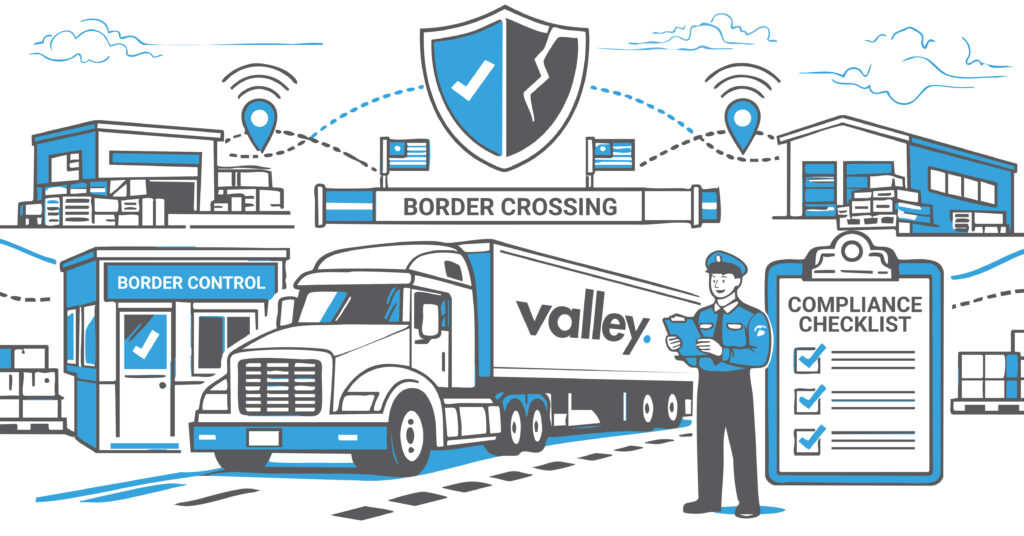
Key takeaway: How cross-border loads affect trucking coverage comes down to one thing: border freight adds moving parts that can change where your policy applies, who is responsible for the load, how claims are documented, and whether a loss falls inside or outside the coverage you thought you had. This matters most for fleets hauling into or out of Mexico or Canada, fleets using partner trucking companies near the border, and fleets moving high-value, refrigerated, time-sensitive, or customs-controlled freight.
Cross-border work looks profitable on the rate sheet. It can also be the load that exposes a weak policy setup.
A lot of fleet owners assume the main question is whether their truck can legally cross. That is only part of it. The bigger insurance question is whether the way the load moves, including handoffs, storage, inspections, subcontracting, trailer swaps, customs delays, and different documentation, still fits the policy language, endorsements, and contracts behind your operation. FMCSA’s international guidance shows that cross-border operations carry separate registration, authority, and compliance issues depending on who is domiciled where and how the operation is structured. CBP adds another layer through truck e-Manifest filing and border processing requirements.
Why border freight changes insurance exposure
A normal domestic load usually has a cleaner chain of custody. One dispatcher. One pickup. One delivery. One jurisdiction. Cross-border loads often do not work that way.
The freight may move through a drop lot, be transferred to another tractor, wait under customs control, sit for inspection, or pass between related and unrelated trucking operations before final delivery. Every one of those steps can change who had possession, who caused the damage, which contract applies, and which insurance carrier gets pulled into the argument. That is why the operational map matters as much as the declarations page.
Border work also increases security exposure. CBP’s CTPAT program for highway carriers focuses on partner screening, seal control, conveyance security, and written supply-chain procedures for a reason. Theft, tampering, cargo substitution, and documentation failures are real claim drivers in cross-border freight.
What changes first when a load goes cross-border
Territory and operating radius
Start with the obvious. Does your policy territory actually match how the load moves?
Some fleets only confirm that the unit is covered in the United States and stop there. That misses the real issue. A cross-border load may involve mileage, storage, or handling outside your normal territory or outside the assumptions your insurance carrier used to price the account. Even if the truck itself is not physically deep into another country, the exposure can still change because the load origin, customs processing, staging, or partner transfer occurs in a different legal and operational environment. FMCSA’s jurisdiction guidance is a good starting point here.
This is where a fleet gets burned by silence. The policy may not automatically fail, but undisclosed border activity can turn a simple claim into a reservation-of-rights fight. Tell your agent what percentage of freight is cross-border, which lanes you run, whether the truck itself crosses, and whether you use relays, drayage partners, or yards near the border.
Partner and subcontractor risk
A lot of border freight involves another trucking company at some point. That could be a drayage partner, a Mexican or Canadian trucking operation, a domestic relay provider, or a yard operator handling trailers before customs release.
That changes risk fast. Your policy may respond one way when your own driver and unit handle the move start to finish, and another way when an outside trucking company takes possession. The key issues are who is hauling under whose authority, who signed the rate confirmation or master agreement, who had care, custody, and control at the time of loss, and whether indemnity language pushes liability back to your fleet. This is not just a contracts issue. It is a coverage issue. FMCSA’s operating authority overview is useful context.
If you use partner trucking companies on border freight, review additional insured wording, hold harmless clauses, waiver of subrogation requests, trailer interchange, and any mismatch between the contract and the actual movement. A clean COI does not fix a bad operational setup.
Cargo timing and custody issues
Cross-border freight creates extra points where cargo can be delayed, inspected, offloaded, resealed, staged, or rejected. That matters because cargo claims are often won or lost on timing and custody.
A shipper may say the product was good at tender and bad at delivery. Your customer may say the delay happened while the freight was under your control. Your insurance carrier may ask for temperature records, seal records, manifest data, border timestamps, inspection notes, and proof of where the trailer sat and for how long. CBP’s truck e-Manifest process exists because timing and shipment data matter before arrival, not just after a problem.
Which coverages usually need a second look
Auto liability and federal filings
This is where people mix up legal filing requirements with actual business protection.
FMCSA requires proof of financial responsibility for certain operations, and authorized for-hire property trucking companies must file public liability coverage to obtain interstate operating authority. FMCSA also says cargo insurance is not required for most property trucking companies, while household goods operations have different filing rules. In plain English, having the required liability filing does not mean your freight, delay exposure, subcontracted movement, or customer contract obligations are fully covered.
If your fleet relies on an MCS-90 endorsement as proof that “the policy will handle it,” slow down. FMCSA describes the MCS-90 as an endorsement required by federal regulation for public liability under the Motor Carrier Act. That is not the same thing as saying every operational loss on a border load is insured the way you expect.
Physical damage, trailer interchange, and non-owned equipment
Cross-border freight often means more dropped trailers, more interchange, more waiting time, and more equipment handled by someone other than your own driver. That raises the odds of a coverage dispute around non-owned trailers, interchange agreements, yard damage, and damage discovered after handoff.
If your fleet pulls customer trailers, leaves trailers in secure lots, swaps equipment near the border, or accepts trailers from another trucking company, do not assume your basic physical damage setup is enough. Trailer interchange and non-owned trailer exposures need to match the way you actually move the freight. This is one of the most common blind spots in border-related claims.
Cargo, reefer, and delay-sensitive freight
Cargo policies are where cross-border assumptions go bad.
High-value consumer goods, electronics, produce, meat, pharmaceuticals, and just-in-time manufacturing freight all create more pressure at the border because delay can be as damaging as direct physical loss. Inspections, missed appointments, temperature drift during waiting time, and rejected loads can turn into ugly disputes even when there was no major crash.
For reefer freight, ask blunt questions. Does your cargo form address temperature deviation clearly? What about power interruption during border delay? What about spoilage after customs hold? What about salvage rights when product is refused? If the answer is fuzzy, fix it before the load moves.
What can trigger claim friction on a cross-border load
Documentation and chain of custody
The more border touches a load has, the more documentation matters.
Expect claim scrutiny around bills of lading, manifest data, seal numbers, border timestamps, delivery exceptions, reefer downloads, inspection notes, interchange receipts, and communications with brokers and shippers. Missing timestamps or missing handoff records can make a valid defense harder to prove. CBP’s ACE and truck manifest guidance show how central pre-arrival and shipment documentation is to truck freight entering the United States.
Customs holds, inspections, and delay
A customs hold is not automatically an insured loss. That is where many fleets get surprised.
A delay may create customer damages, missed production windows, perishability issues, detention fights, or chargebacks without fitting neatly into the cargo coverage grant. Border inspection also raises contamination and tamper allegations, especially if the load is resealed, partially unloaded, or sits longer than planned. From a claims standpoint, delay and physical loss are not the same thing, and policies often treat them very differently.
Jurisdiction, venue, and contract wording
Cross-border claims can get messy because more than one legal system, more than one contract, and more than one party may be involved.
That does not always mean your fleet is uncovered. It does mean the path to payment can get slower and more expensive. The claim can turn on which agreement controlled the movement, whether the trucking company that actually moved the freight was authorized the way the paperwork said, and whether the loss happened before or after a transfer point. This is why border freight should trigger a contract review, not just a certificate request. FMCSA’s cross-border jurisdiction page is worth reviewing.
A practical review checklist before your fleet takes the load
Before your fleet says yes to regular cross-border freight, review these points with your agent and your operations team:
- Confirm where the truck, trailer, and cargo will actually travel, stage, wait, and transfer.
- Confirm whether your own unit crosses the border or whether a partner trucking company handles part of the movement.
- Review policy territory, operating radius assumptions, and any border-related underwriting disclosures.
- Review trailer interchange, non-owned trailer, and drop-lot exposures.
- Review cargo wording for theft, reefer breakdown, spoilage, delay-related disputes, and salvage.
- Review broker, shipper, and partner contracts for indemnity and insurance requirements.
- Tighten documentation procedures for seals, timestamps, temperature logs, inspections, and handoffs.
- If hazmat is involved, verify FMCSA and PHMSA registration and rule requirements tied to the commodity and packaging.
The point is simple: cross-border freight is not just another lane. It is a different exposure profile.
If your fleet is starting cross-border freight, or if border loads have grown from occasional to routine, now is the time to review the account before a claim does it for you. Valley Trucking Insurance can help you compare your lanes, contracts, filings, and policy structure so you can see where the exposure really sits and tighten coverage before the next load moves.
FAQ
Does my U.S. trucking policy automatically cover cross-border loads?
Not necessarily. It depends on policy territory, how the load moves, who handles each leg, and what endorsements and contracts apply.
Is cargo insurance federally required for cross-border property freight?
Usually no for general property trucking companies, but FMCSA still requires public liability filings for many authorized for-hire operations, and household goods operations have different cargo filing requirements.
What is the biggest hidden risk on border freight?
Handoffs. Trailer swaps, drop lots, subcontracting, and unclear custody create some of the ugliest claim disputes.
Can a customs delay create an uninsured loss?
Yes. Delay-related damages do not always fit the same way direct physical cargo loss does.
Do reefer loads need special attention on cross-border moves?
Absolutely. Border wait time, inspection time, and temperature documentation can make or break the claim.
Is a certificate of insurance enough when I use a partner trucking company?
No. A COI is not a substitute for reviewing the contract, operational flow, and actual coverage wording.
What if I haul hazmat across the border?
Treat it as a separate review. Verify current FMCSA, PHMSA, and customer requirements for the commodity, packaging, registration, and insurance structure.
Reviewed by Cameron Pechia, Agency Partner, WA Insurance License 71186
Last reviewed: 03/11/2026

Smarter Coverage. Real Support. No Hassle.