🔔 Announcement: American Trucking Insurance is now a part of Valley!
See details
🔔 Announcement: American Trucking Insurance is now a part of Valley!
See details

Why High-Value Partial Loads Make Cargo Claims So Much Harder

Cameron Pechia / Jun 10, 2026
Reviewed by Cameron Pechia, Founder, WA Insurance License 71186
Last reviewed: 4/15/2026
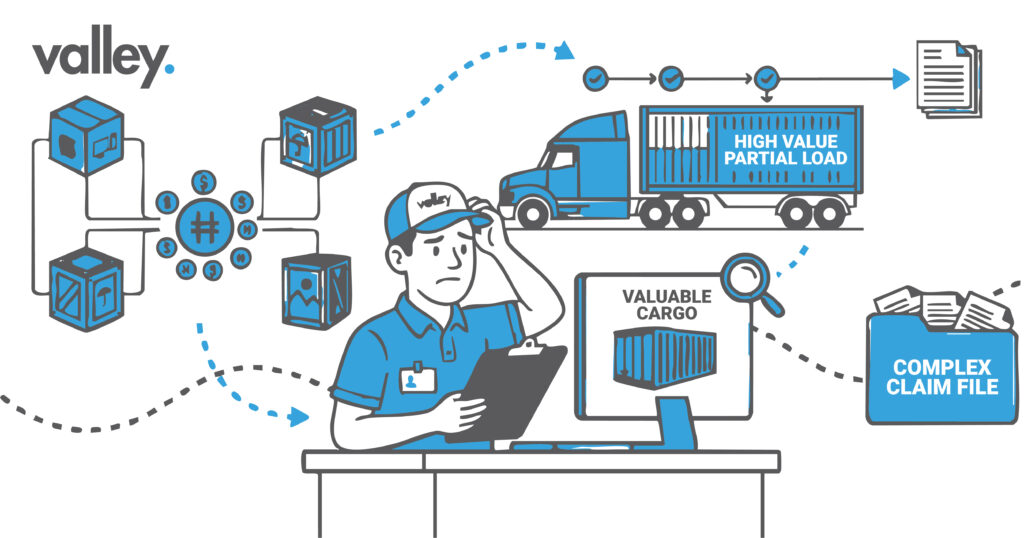
Key takeaway: A high-value partial load is a shipment where freight worth significantly more per pound or per unit than standard general cargo rides in a trailer that is not full, often alongside other shippers’ goods. These loads are common in LTL (less-than-truckload) operations and in situations where a fleet owner pulls a spot load that doesn’t fill the trailer. They create claims complexity because most motor truck cargo policies are built around full truckloads of a known commodity — not mixed freight with unequal values, multiple interested parties, and cargo the driver may not have inspected. If you haul partial loads regularly and your policy hasn’t been reviewed with that in mind, there’s almost certainly a gap.
You pull a load. Half a trailer. Electronics, medical equipment, or some other freight that weighs almost nothing but is worth more per pallet than most full truckloads. The rate confirmation looks fine. The bill of lading lists the cargo. You deliver most of it without a problem.
Then one pallet comes up short. Or arrives damaged. And the claim that follows is not simple.
High-value partial loads — sometimes called HVPLs in coverage discussions — are one of the most consistently mishandled claim scenarios in trucking. Not because the damage is unusual. Because the policy language, the documentation habits, and the liability chain were all built for a different type of freight. When the cargo is mixed, partially loaded, and worth a lot, the claim touches every weak spot in a motor truck cargo policy at once.
Here’s where it goes wrong and what to do about it before a loss happens.
What Is a High-Value Partial Load, and Why Does It Matter for Claims?
A high-value partial load is exactly what it sounds like: a shipment where the freight value is disproportionately high relative to weight or volume, and the trailer is not carrying a single shipper’s full load. You’ll see this most often in LTL freight, in brokered spot loads where the shipper only has partial volume, or in operations that regularly mix commodities to fill a trailer.
The claims complexity starts here: standard motor truck cargo policy limits are often written in terms of per-occurrence dollar amounts, not per-pound or per-item values. A policy with a $100,000 per-occurrence limit made sense when you were hauling dry goods at $0.50 a pound. It doesn’t hold up when a single pallet of industrial equipment or consumer electronics is worth $80,000 on its own.
When a loss occurs on a partial load, the adjuster has to determine which portion of the load was damaged, who was the responsible shipper, what the declared value was, and whether the policy language even covers the commodity in question. On a full truckload of a single commodity from a single shipper, that process is straightforward. On a partial load with three shippers and four commodity types, it isn’t.
How Your Motor Truck Cargo Policy Reads a Partial Load
Motor truck cargo (MTC) insurance is the coverage most fleet owners think of as their “cargo policy.” It’s designed to protect the fleet owner’s legal liability for freight under their care, custody, and control while in transit. The mechanics of how that coverage applies — particularly on high-value partial loads — have two specific weak points.
The Declared Value Problem
When a bill of lading is created, the shipper declares the value of the goods being shipped. If the value is not declared, the cargo policy and the Carmack Amendment default to a per-pound liability calculation or the tariff limit set in the bill of lading. For high-value freight — electronics, pharmaceuticals, precision equipment — that default calculation almost never gets close to actual market value.
Here’s the field reality: a lot of drivers don’t scrutinize the bill of lading at pickup for declared value. That’s not laziness; it’s habit. When the freight is a pallet of industrial parts that looks identical to the last 50 pallets they’ve loaded, no one is checking whether the declared value matches. When those parts are worth $60,000 and the bill of lading says “value not declared,” the claim gets paid at pennies on the dollar — and the fleet owner absorbs the gap.
Mixed Freight and the Per-Occurrence Limit Trap
Most cargo policies have commodity exclusions or per-item sublimits buried in the endorsements. Electronics, jewelry, artwork, and pharmaceuticals are common exclusions. Partial loads, almost by definition, are more likely to carry one of these commodities than a standard full truckload of a single shipper’s goods.
When the per-occurrence limit on the policy is $100,000 and the partial load contains a mix of general freight plus one excluded commodity, the policy pays on everything except the item that caused the largest single-item loss. That’s not a hypothetical. It’s a scenario I’ve seen play out more than once at renewal when a fleet owner is trying to figure out why the claim paid out so far below what they expected.
The Carmack Amendment and Who Actually Owes What
The Carmack Amendment is the federal statute governing liability for cargo damage in interstate transportation. Under it, a motor carrier is held to a near strict-liability standard for actual loss or injury to cargo in its care. The shipper does not need to prove negligence. If the freight left in good condition and arrived damaged, the burden is on the fleet owner’s operation to prove a defense.
For high-value partial loads, Carmack creates a specific problem: liability is tied to the condition of the freight at pickup. If the driver signs a bill of lading showing “apparent good order” without actually inspecting the freight — which happens constantly on palletized loads where the outer packaging looks intact but the contents aren’t visible — the fleet owner just signed away their primary defense. The bill of lading is now evidence that the goods were received undamaged. Whatever the adjuster finds at delivery is on the fleet operation.
Carmack also allows a motor carrier to limit liability to an agreed value, but that agreement has to be documented at the time of shipping, reflected in the bill of lading, and the shipper must be offered the option to declare a higher value. On a brokered partial load, that negotiation often doesn’t happen. The rate gets confirmed, the truck shows up, and both parties assume the other party handled the paperwork.
Where Freight Broker Liability Enters the Picture
Partial loads are brokered loads more often than not. That means a freight broker arranged the transaction, and the liability question gets more layered. Brokers are not motor carriers. Under the Carmack Amendment, they are not directly liable for cargo loss the way a fleet owner operating under their own authority is.
But that doesn’t mean the broker is off the hook for everything. Freight broker liability under negligent selection theory holds brokers responsible when they place a load with a fleet operation that isn’t properly qualified, licensed, or insured — and a loss results. On high-value partial loads, this matters because the broker’s selection decision and the fleet owner’s cargo coverage are both in play when the claim is investigated.
If your operation is regularly accepting brokered partial loads with high-value commodities, your policy should be reviewed with that brokerage relationship in mind. The broker’s contingent cargo coverage — if they have it — may or may not respond to your specific loss scenario. Assuming it will is how fleet owners get stuck holding an uncovered claim on a load they thought somebody else’s policy would handle.
What “Care, Custody, and Control” Really Means on a Partial Load
Motor truck cargo coverage applies while the freight is in the fleet owner’s care, custody, and control (CCC). That phrase is well understood on a full truckload where the fleet picks up at origin, seals the trailer, and delivers to a single destination. On a partial load, the CCC question is more complicated.
Is the freight still in CCC during a multi-stop delivery? When a driver drops one pallet from a partial load at Stop 1 and the remaining freight is damaged between Stop 1 and Stop 2 — and the trailer was opened and partially unloaded — is that a break in custody? Policy language varies on this. Some MTC policies explicitly cover multi-stop loads. Others require a separate endorsement. Some have language that creates ambiguity about a “constructive delivery” at the first stop that could theoretically reduce or eliminate coverage on the remaining freight.
This is not a question most fleet owners think to ask when they’re buying coverage. It’s the kind of thing that surfaces when a claim is already in progress, the adjuster pulls out the policy, and everyone is reading the endorsements for the first time.
The Documentation Gap That Kills Claims
When a high-value cargo claim hits, the adjuster is going to want five things:
- The bill of lading, including declared value notation
- The rate confirmation from the broker (for brokered loads)
- Proof of cargo condition at pickup (photos, inspection notes, driver notation)
- Delivery receipt with any exception noted at drop
- The commodity description with sufficient detail to assess per-unit value
On a well-documented full truckload, most of this exists. On a partial load, especially a brokered spot load, documentation is often incomplete. The bill of lading may have a generic commodity description. There are rarely pickup photos. The driver may not have noted any exceptions at delivery because the freight appeared intact on the outside.
Without documentation, the claim process slows to a crawl. Carriers require substantiation. The adjuster can’t confirm condition at origin. If the value wasn’t declared on the bill of lading, the per-pound calculation kicks in. The fleet owner’s motor truck cargo policy pays out on what can be proved — and what can be proved on an underdocumented partial load is usually less than what was lost.
The fix is simple in theory: build documentation habits into your dispatch and driver workflow before the load ever moves. A photo at pickup costs nothing. A driver notation on the bill of lading for any packaging irregularities costs ten seconds. These habits don’t just protect claims — they protect your fleet’s liability exposure under Carmack.
How to Structure Coverage for High-Value Partial Loads
If your operation hauls partial loads with some regularity, especially brokered loads, your motor truck cargo policy needs to reflect that. Specifically, ask your broker these questions before your next renewal:
What commodities are excluded? Every MTC policy has a commodity exclusion list. Electronics, pharmaceuticals, jewelry, and fine art are common. If your partial loads include any of these commodities — even occasionally — you need either a scheduled endorsement or a separate policy that covers them.
What is the per-occurrence limit relative to the highest-value load you haul? If the answer is “I don’t know what the highest-value load I haul is worth,” that’s the problem. Spot and brokered loads can be worth multiples of what a standard renewal discussion assumes.
Does the policy cover multi-stop loads without restriction? If your partial loads involve multiple delivery stops, confirm in writing whether the policy treats each stop as a separate CCC period or as a continuous one.
Is there a requirement for declared value documentation at pickup? Some policies require the driver to confirm or record declared value as a condition of coverage. If yours does, is that actually happening in your operation?
How does the policy handle broker-arranged loads? If a freight broker’s contingent cargo coverage is supposed to respond first on a brokered loss, your policy needs to specify how it coordinates with that coverage — not just assume the broker’s policy handles it.
The FMCSA insurance filing requirements establish the baseline for what you must have to operate. They don’t establish what you actually need to protect your operation from a high-value cargo loss. Those are two different conversations.
If you’re hauling partial loads and your coverage hasn’t been reviewed with that specific exposure in mind, reach out to the team at Valley Trucking Insurance for a full coverage review. We look at what you’re actually hauling — not just what your last renewal assumed you were hauling. Start the conversation at Valley Trucking Insurance.
Frequently Asked Questions: High-Value Partial Loads and Cargo Claims
What makes a partial load harder to insure than a full truckload?
Partial loads often involve mixed freight, multiple shippers, undeclared values, and brokered arrangements — all of which create ambiguity in who is liable, what the cargo is worth, and whether the policy applies as expected. A full truckload from one shipper with a known commodity is a much cleaner coverage scenario.
Does my motor truck cargo policy automatically cover high-value freight?
Not necessarily. Most MTC policies have commodity exclusions, per-occurrence sublimits, and declared value requirements that can all reduce or eliminate coverage on high-value items. You need to review the actual policy language, not just the coverage limit on your certificate.
What is the Carmack Amendment and does it help or hurt fleet owners?
The Carmack Amendment governs cargo liability in interstate transportation. It places a near strict-liability standard on fleet owners for actual cargo loss. It can help by creating a clear claims framework, but it hurts if your documentation is weak — because it puts the burden on the fleet to prove a defense, not on the shipper to prove negligence.
Does a freight broker’s cargo coverage protect my fleet on a brokered partial load?
Not directly. Freight brokers may carry contingent cargo coverage, but it typically responds when the motor carrier’s own policy does not — and the terms vary significantly by broker. Never assume a broker’s coverage fills a gap in your policy without confirming the terms in writing.
What should a driver do at pickup to protect a high-value cargo claim?
Document everything. Photograph the freight before it’s loaded, note any packaging irregularities on the bill of lading, confirm the commodity description matches what’s actually on the truck, and verify the declared value if the load is high-value. These steps cost minutes and protect the entire claim.
What is “care, custody, and control” and why does it matter for partial loads?
Care, custody, and control (CCC) defines the period during which your cargo coverage applies. On multi-stop partial loads, there is sometimes ambiguity about whether coverage continues through all stops or whether it resets after each delivery. Confirm your policy’s language on multi-stop loads before you haul them.
How do I know if my cargo coverage limit is high enough for partial loads?
Look at the highest-value load you’ve hauled in the past 12 months. If your per-occurrence limit is below that number, you have an exposure gap. For operations that regularly take brokered spot loads, the variance in load value can be significant — check your limit against your actual load data, not just your typical freight profile.
Can I add coverage for excluded commodities on a partial load?
Yes, in most cases. Commodity exclusions can often be addressed through a scheduled endorsement, a separate inland marine policy, or a high-value cargo rider. The specifics depend on the commodity and the underwriter. This is something to discuss with your broker at renewal — or before renewal if you’re hauling excluded commodities now.

Smarter Coverage. Real Support. No Hassle.