🔔 Announcement: American Trucking Insurance is now a part of Valley!
See details
🔔 Announcement: American Trucking Insurance is now a part of Valley!
See details

The Insurance Risk Behind Detention and Dwell Time Delays

Cameron Pechia / Apr 8, 2026
Reviewed by Cameron Pechia, Founder, WA Insurance License 71186
Last reviewed: 4/08/2026
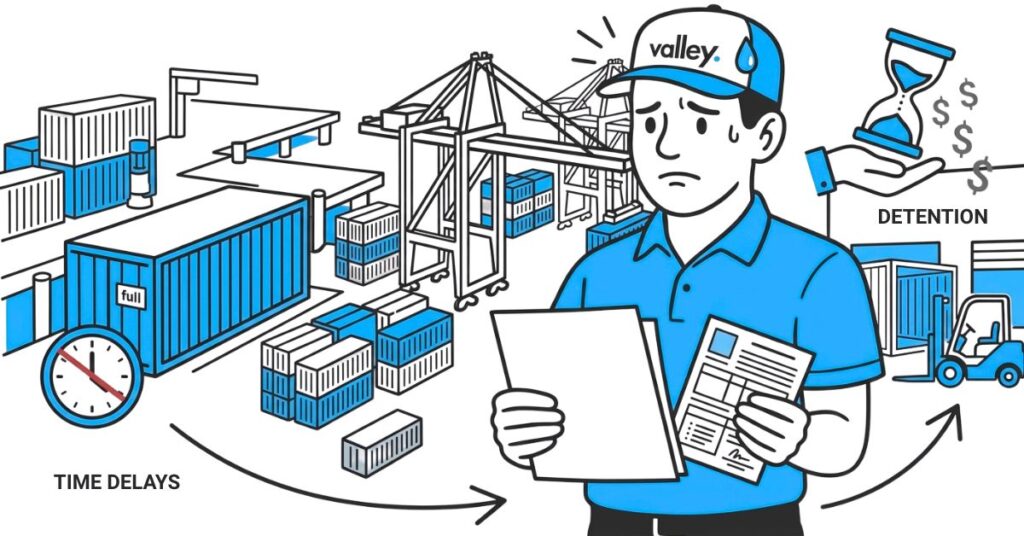
Key takeaway: Trucking detention time insurance risk is real, underreported, and not automatically covered. Detention time — the period a driver waits beyond the standard free time at a shipper or receiver — creates overlapping exposure across cargo coverage, hours of service (HOS) compliance, and third-party liability. It affects owner-operators and fleets of all sizes, but smaller operations feel it hardest because they have less leverage to push back and fewer policy provisions built to handle it. If your current coverage doesn’t address what happens to your cargo liability and accident risk during extended dock waits, you have a gap.
Your driver showed up on time. The dock wasn’t ready. Two hours turned into four. He’s now burning through his 14-hour window sitting in a lot, and the load hasn’t moved.
That’s not just a pay dispute. It’s an insurance problem.
Detention and dwell time are some of the most frustrating operational realities in trucking — and one of the most overlooked sources of coverage exposure. Most fleet owners know detention costs them money in driver pay and lost loads. Fewer understand what it does to their insurance position. This post covers the specific risks, where the coverage gaps show up, and what to do about them.
What Is Detention Time and Why Does It Matter for Insurance?
Detention time is the period a driver spends waiting at a shipper or receiver beyond the standard free window — typically two hours after the scheduled appointment. Dwell time is the broader term: the total time a truck spends at a facility, including both the free period and any detention beyond it.
These aren’t just operational nuisances. The FMCSA has documented that detention time occurs on roughly 1 in every 10 stops, with average overages running more than an hour past the two-hour standard. A separate 2018 OIG study found that detention time costs for-hire drivers more than $1 billion annually in lost earnings — and that even a 15-minute increase in average dwell time raises the expected crash rate by over 6 percent.
That crash rate connection is where insurance comes in. Extended waits don’t just waste time. They pressure drivers to push harder once they’re moving. They create HOS conflicts that put fleets in compliance jeopardy. And they leave cargo sitting in ambiguous liability territory that most standard motor truck cargo policies weren’t written to handle cleanly.
How Detention Time Pushes Drivers Into HOS Violations — and Why That’s an Insurance Problem
The federal HOS rules are straightforward on paper: property-carrying drivers get 11 hours of driving time within a 14-hour window after coming on duty. Off-duty time does not stop the 14-hour clock.
A driver who came on duty at 6 a.m. and sat at a dock for four hours is still burning his 14-hour window. He may have only driven two hours. But he’s already 6 hours into his day, and the clock won’t pause while he waits. By the time he’s loaded and rolling, he’s playing catch-up — and the pressure to make the delivery appointment can push judgment in the wrong direction.
This matters for your insurance in a specific way. When a post-accident investigation reveals that a driver was tight on hours at the time of a crash — or had been running a compressed schedule due to repeated detention delays — that record becomes part of the liability picture. Plaintiff attorneys know how to read ELD data. If your drivers are regularly squeezed on time because shippers hold them for hours, and a crash happens, the argument that your fleet was operating under chronic fatigue pressure is not hard to make. Your auto liability coverage will respond. But your exposure — in terms of settlement size and CSA score impact — goes up significantly when the HOS context tells a bad story.
The Cargo Coverage Gap No One Talks About During Dwell Time
When Does Cargo Coverage Actually Apply at a Shipper or Receiver?
Motor truck cargo policies cover freight while it’s in the care, custody, and control of the trucking operation — specifically while it’s being transported. The policy language around pickup and delivery windows varies, but most policies define coverage as attaching when the driver takes possession of the load and detaching when it’s delivered and accepted.
The question nobody asks until a claim gets denied: what about the four hours the driver sat at the dock before the freight was formally loaded? Or the three hours he waited after delivery while the receiver was doing count?
Coverage during those windows is not automatic. Some policies attach at the time of tender (when the freight is staged for pickup). Others require the driver to have physical possession and the bill of lading to be signed. If your driver is on-site, the load is accessible, but paperwork hasn’t transferred — and something happens to the freight — you may be in a gap.
This is a real scenario, not a hypothetical. Freight has been damaged by forklift operators during staging, stolen from trailers while drivers waited, and contaminated by facility conditions while the truck sat at a dock. The coverage answer depends entirely on how your specific policy defines the attachment point, and most fleet owners have never asked that question.
The “Care, Custody, and Control” Problem While You Wait
Cargo coverage operates on a care, custody, and control basis. The moment a driver takes the load, the liability clock starts. But dwell time creates a gray zone. Your driver is on-site. The freight is in or near his trailer. But the shipper’s staff is still actively working the load — moving pallets, sealing the trailer, running counts.
Who controls the freight in that window? Both parties have a hand in it. If something goes wrong, the shipper will say their staff was still responsible. Your policy may say your driver was in possession. Neither answer is clean, and neither pays fast.
The practical risk here isn’t just the coverage ambiguity — it’s the claims dispute timeline. If cargo is damaged during a dwell period, expect a fight over which party’s coverage responds. That fight takes time and money regardless of how it resolves. The trucking operation almost always absorbs some of that cost, either in legal fees, a coverage gap, or the deductible.
Who’s Liable When Something Goes Wrong During a Delay?
The Shipper Says It’s Not Their Problem
Shippers and receivers have their own legal exposure during dock operations, but they are not automatically liable for what happens to freight while it’s in a trailer on their lot. Their premises liability coverage and inland marine policies are designed to protect their operations — not yours. If they damage freight during extended handling or delay and it results in a cargo claim, they will point to your bill of lading and the Carmack Amendment as establishing your liability as the transporting operation.
The Carmack Amendment sets the baseline: the trucking operation (motor carrier) is liable for freight loss or damage during transport. Shippers use that framework to deflect. Unless your contract with the shipper specifically assigns liability for damage that occurs during their detention-caused delays, you are likely holding the bag.
Your Policy May Say the Same Thing
Motor truck cargo insurers look at how a loss occurred. A cargo claim that originates from damage done while freight was being handled by shipper staff — not in transit, not during driver-controlled operations — may fall outside the standard policy intent. Adjusters will ask for the timeline. If the damage window aligns with a dwell period when the shipper’s team was actively working the load, expect a coverage argument.
This isn’t a carrier being unreasonable. It’s the policy doing what it was designed to do: cover transit losses, not facility losses. The gap lives in the dwell period. And most trucking operations have no endorsement, no rider, and no contract language specifically addressing it.
What Your Rate Confirmation and Bill of Lading Don’t Protect You From
Your rate confirmation establishes the freight charges and detention pay terms. Your bill of lading documents the condition of freight at pickup and delivery. Neither document does anything to assign liability for what happens during a multi-hour dwell period at a facility.
Detention pay provisions in a rate confirmation tell you when you get paid extra for waiting. They say nothing about who is responsible if the freight is damaged, stolen, or compromised during that wait. A rate confirmation is a payment document. Don’t mistake it for a liability document.
The same is true of the bill of lading. The BOL records the freight condition at the time it was signed. It does not create an ongoing liability transfer that protects your cargo policy from a gap claim during a pre-signature dwell period. Experienced freight lawyers know this. If you’ve never walked through your rate confirmation template and your BOL with your insurance broker specifically to identify dwell-period liability language — or the absence of it — that conversation is overdue.
How to Reduce the Insurance Exposure From Detention Time
There is no single coverage endorsement that resolves every detention-related exposure, but there are specific steps that reduce it:
Know exactly when your cargo coverage attaches. Pull your motor truck cargo policy and find the attachment and detachment language. Ask your broker to explain the coverage position during pre-loading and post-delivery dwell periods. If the answer is vague, that’s a gap worth addressing.
Document everything with timestamps. Your ELD already captures HOS data. Make sure your drivers are also logging arrival times, dock assignment times, loading start and end times, and departure times at every stop. This documentation is your defense if a cargo claim or HOS dispute follows a detention event.
Review your contracts with brokers and shippers. Rate confirmations from load boards like DAT and Truckstop set detention pay terms but rarely assign liability for dwell-period damage. If you’re hauling under consistent agreements with specific shippers, negotiate dwell-period liability language into the contract.
Ask about contingent cargo coverage. If you’re brokering loads, your contingent cargo policy may respond differently than a direct motor truck cargo policy during dwell periods. Know the difference and know which policy applies to which freight.
Talk to your broker after significant detention events. If a driver regularly sits four-plus hours at a specific facility, that’s a documented pattern that may affect your HOS compliance record and your claims history. Your broker needs to know about operational patterns like that — not just when a claim happens.
FMCSA’s research on detention time and safety makes clear this isn’t just a pay issue. It’s a fatigue issue, a compliance issue, and — for anyone running for-hire freight — an insurance issue that starts before your driver ever pulls away from the dock.
If you’re not sure how your current cargo coverage handles dwell-period exposure, or if your HOS pattern from detention events could be creating liability risk you haven’t priced into your coverage limits, that’s worth a direct conversation. Valley Trucking Insurance works with fleet owners to find the specific gaps in their current coverage and address them before a claim makes it obvious. Start the review at Valley Trucking Insurance.
Frequently Asked Questions
Does motor truck cargo insurance cover freight damaged during detention time?
It depends on when your policy defines coverage as attaching. Most motor truck cargo policies cover freight while it’s in the care, custody, and control of the trucking operation during transport. Damage that occurs during a pre-loading or post-delivery dwell period — particularly when shipper or receiver staff are still actively handling the freight — may fall outside standard coverage. Review your policy’s attachment language with your broker.
Can detention time cause a violation on my driver’s record?
Detention time itself isn’t a violation, but the knock-on effect can be. If a driver burns through his 14-hour window at a dock and then drives beyond legal limits to make a delivery, that’s an HOS violation — and it shows up on his record and in your CSA data. ELDs capture this automatically.
Who is responsible for freight damage that happens while a driver is waiting at a shipper?
Liability depends on who had physical control of the freight at the time of damage and what your contract says. The Carmack Amendment establishes the trucking operation’s baseline liability during transport, but shipper-caused damage during a dwell period is a legitimate basis for a claim against the shipper. Without specific contract language assigning that liability, the dispute will take time and money to resolve.
Does my rate confirmation protect me if something happens to freight during a dwell period?
No. A rate confirmation is a payment document. It establishes detention pay terms but does not assign or transfer liability for cargo damage during dwell periods. You need contract language and coverage language to address that exposure — not a rate confirmation.
How does detention time affect my CSA score?
Detention time itself doesn’t appear directly in CSA scoring. But HOS violations that result from detention-driven schedule compression do. Violations get assigned to your USDOT number and affect your Safety Measurement System scores, which influence roadside inspection selection and can affect your insurability over time.
Is there a standard free time before detention pay kicks in?
The industry standard is two hours after the scheduled appointment before detention pay begins, but this is not a federal regulation — it’s a contractual convention. Your rate confirmation or shipper agreement governs what applies on any specific load. FMCSA has documented the two-hour benchmark in its research on detention time but has not mandated it by rule.
Should I report recurring detention events to my insurance broker?
Yes — particularly if detention at specific facilities is creating a pattern of compressed HOS windows for your drivers. Brokers who specialize in trucking insurance need to understand your operational risk profile, not just your vehicle count. A pattern of four-hour dwell times at certain accounts is underwriting-relevant information.
What’s the difference between dwell time and detention time?
Dwell time is the total time a truck spends at a facility — including the free window before detention pay begins. Detention time is specifically the period beyond that free window. Insurance exposure can exist during both, depending on when your cargo coverage attaches and what was happening to the freight at the time of a loss.

Smarter Coverage. Real Support. No Hassle.